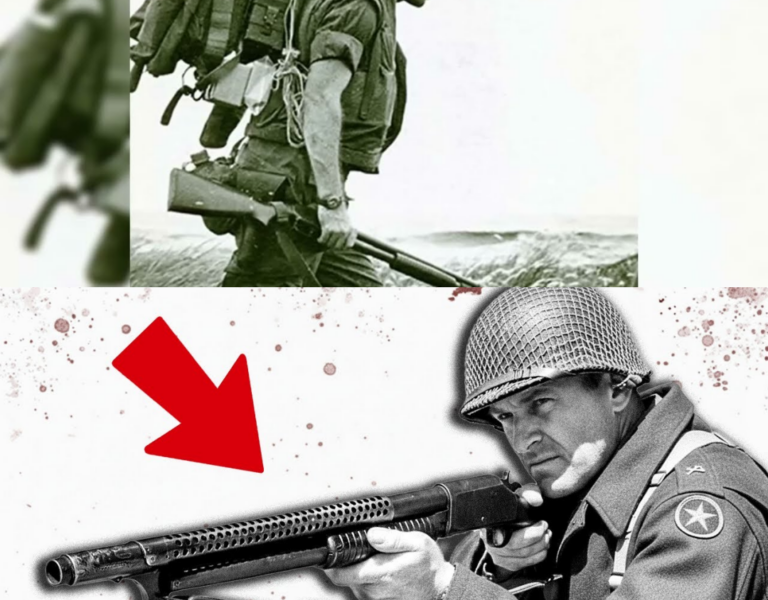

The Dark Reason Germans Hated the American M1897 Trench Gun
In World War I, death usually came from far away. Machine guns firing across no man’s land, but the American M1897 trench gun was effective at close range. In the narrow, muddy trenches of Europe, German soldiers began reporting something different. Entire squads disappear in seconds. They were neither given any warning nor any time to escape. just a round of fire and the bodies were left where they stood. And this destruction did not come from a rifle or a machine gun. It came from a shotgun designed for
one thing, clearing trenches fast. The M1897 could fire again and again without letting go of the trigger, turning tight corridors into death traps. German commanders hated it so much they filed an official protest demanding it be banned as violations of international law. So what made this weapon so terrifying that it broke the rules of war itself? World War I completely changed how wars were fought. Old tactics like cavalry charges and open field battles couldn’t hold their ground under machine guns,
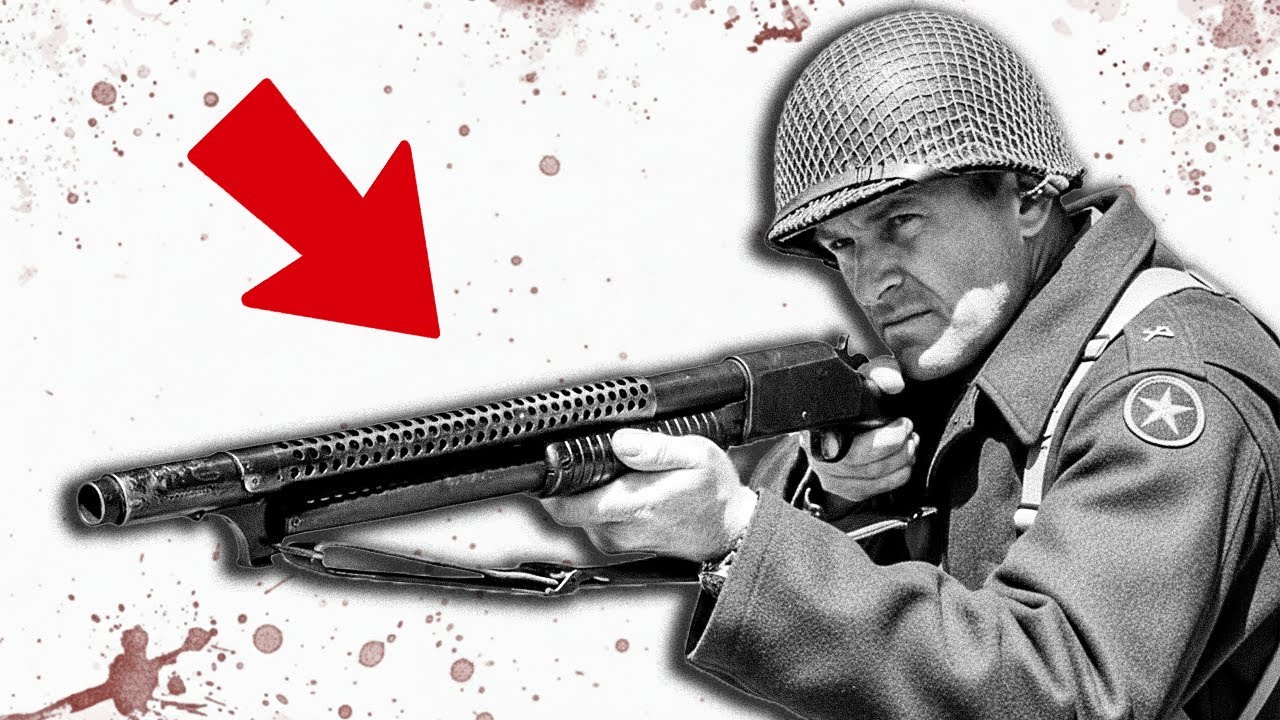
artillery, and miles of trenches. Combat became slow, brutal, and extremely close. And when fighting moved underground into narrow trenches, traditional rifles suddenly became a problem. That is where the American M1897 trench gun came in. This was a military adapted shotgun built for close quarters combat. Its barrel was shortened so it could be used in tight spaces without getting caught on walls or corners. Many models also had a heat shield and a bayonet mount, turning the weapon into both a firearm and a
lastditch melee tool. What made the trench gun truly dangerous was its firepower. Loaded with 12 gauge buckshot, each trigger pull sent multiple pellets downrange at once. In the confined space of a trench, that meant devastating results. A single blast could clear a section instantly, allowing troops to push forward and secure ground, much like creating a small beach head inside the enemy’s defenses. Most importantly, it did not require perfect aim. Speed and spread mattered more than precision. In an
environment where fights happened at arms length, that advantage was enormous. It gave American soldiers a weapon ideally suited to the reality of trench warfare, which was fast, brutal, and overwhelmingly effective at close range. And that effectiveness is precisely why it terrified the enemy. The story of the Winchester Model 1897 begins long before trenches, bayonets, or Europe on fire. It starts in the 1890s during a quiet revolution in firearms. smokeless powder had arrived and suddenly many older guns built for
black powder were no longer strong enough. This single change forced gun makers to rethink everything they knew about weapon design. However, a particular man, John Moses Browning, was already ahead of the curve. Browning had designed the Winchester Model 1893, one of the first successful pumpaction shotguns. It worked well, but it wasn’t built to handle the higher pressures of smokeless powder. Winchester knew that if they wanted to survive this new era, they needed something more challenging.
So, Browning went back to work. The result was the Winchester Model 1897. Released as a stronger, improved design, the 1897 could safely fire powerful smokeless shells while cycling them quickly and reliably. It featured a steel frame, an exposed hammer, and a tubular magazine that held five rounds plus one in the chamber. The pumpaction system allowed rapid follow-up shots, and its simple construction made it easy to use and repair. Winchester even went a step ahead and offered it in multiple gauges and configurations. Be it
long-barreled hunting guns or shorter versions, he made sure the American forces had everything they needed. At first, the Model 1897 was purely a civilian success. Hunters used it for birds and small game. Law men valued their power and intimidation. Express companies and correctional officers trusted it to protect valuables and maintain order. It earned a reputation as a working man’s gun. Not fancy, not delicate, but dependable under hard use. Then, World War I changed everything. When the United States entered the war
in 1917, American soldiers were thrown into a battlefield unlike anything they had trained for. Trenches were narrow, dark, and deadly. Long rifles were slow and awkward. Pistols lacked stopping power. Soldiers needed a weapon that could end a fight instantly at arms length. The Model 1897 was the perfect answer. Winchester modified the shotgun for combat, creating what became known as the trench gun. The barrel was shortened to 20 in for more effortless movement in tight spaces. A perforated steel heat shield was added to prevent
burns during rapid fire. A bayonet lug allowed soldiers to attach the long M1917 bayonet, turning the shotgun into a spear when ammunition ran dry. Loaded with 12 gauge buckshot, the trench gun was devastating. Each shell fired multiple large pellets with a single pull of the trigger. Perfect aim wasn’t required. One blast could clear a section of trench, creating a foothold for troops to pour in and push forward. One feature made it even more terrifying, the lack of a disconnector. Soldiers could hold the trigger down and
fire every time they pumped the action, a technique later known as slamfiring. In the cramped corridors of trench warfare, the shotgun became a storm of lead. German troops quickly learned to fear it. Even after the war ended, the M1897 was yet to see much more battlefields and deliver a horrifying performance. Because this gun was never meant to be legendary, it was supposed to work. And in war, that is often what matters the most. The effectiveness of the M1897 wasn’t just seen in the way it
shot soldiers down, but in the fear it instilled in people. German soldiers didn’t just fear the blast of buckshot. They feared what it represented. Sudden, unstoppable death at close range. Reports from the trenches described entire squads vanishing in seconds, taken down by volleys of pellets from weapons they had never trained to fight. Unlike rifles, which required aim and distance, or machine guns, which could be avoided with cover, the trench shotgun turned every corner into a kill zone. By mid 1918, the German government
was officially alarmed. They had seen enough. Soldiers captured with the M1897 described its use with horror. One account described a trained trapshooter, a civilian marksman brought to the front using the shotgun to deflect grenades and mow down advancing troops. Another told of six shells fired in seconds from slam fire mode, each unleashing 54 lead pellets into confined trench spaces. The result was carnage. entire attacks could be neutralized almost instantly. This effectiveness led to an extraordinary
diplomatic move. On September 15th, 1918, Germany sent a formal protest to Washington via neutral embassies. The note cited article 23E of the HEG conventions, which forbade weapons causing unnecessary suffering, and warned that American soldiers captured with the shotgun or its ammunition could be executed. Germany’s argument was simple. The weapon was too brutal, too devastating, and violated the accepted rules of warfare. American officials, however, saw it differently. Secretary of War Newton D. Baker and Brigadier
General Samuel T. Anel reviewed the protest and dismissed it outright. They noted that the M1897’s pellets were only slightly larger than rifle bullets, and that other weapons, machine guns, grenades, bayonets, and even chemical gas caused far worse injuries. The key, Anel argued, was context. The shotgun was intended to neutralize the enemy quickly and effectively in close quarters combat. Its purpose was efficiency, not cruelty. It was no more illegal than a rifle or a shrapnel shell. Still, the German concern told a
truth about warfare. Fear is as lethal as firepower. Soldiers described the psychological terror of hearing the pumpaction cycle. Knowing that one misstep meant instant death, the surprise, speed, and volume of destruction. The M1897 delivered in narrow trenches created a sense of helplessness among German troops. It was a weapon that forced soldiers to rethink how to fight and in some cases how to survive. The protest failed. Washington ignored the warning and no American was executed for carrying a trench shotgun. Yet the
story alone lives for generations because it showed just how revolutionary and feared the M1897 had become. By the war’s end, the M1897 had earned a reputation that outlasted the trenches themselves. For Germany, the protest was a desperate acknowledgement that in the chaos of modern combat, some weapons were simply too effective to ignore. And in that effectiveness lay the reason the M1897 remains legendary more than a century later. A gun that broke the rules of war not because it was illegal,
but because it simply worked too well. The M1897’s military career began quietly before World War I. While most know it as a trench weapon, it first proved itself in earlier conflicts where close-range fighting demanded fast, decisive firepower. During the PhilippineAmerican War, soldiers discovered that Morrow fighters, who often attacked in sudden, tight formations with knives and machetes, could be stopped effectively by the rapid spread of buckshot. The shotgun’s multiple projectiles gave US
forces an advantage that rifles couldn’t match in chaotic skirmishes. By the 1910s, the M1897 was also carried into border conflicts such as the Poncho Villa expedition in Mexico. American troops tasked with countering raids and ambushes relied on the shotgun to quickly neutralize threats at short distances. These early experiences helped military planners understand that the weapon strengths were most pronounced in close quarters scenarios, something that would later define its use in the trenches of Europe. When the
US joined World War I in 1917, the Army adapted the M1897 into a weapon explicitly for trench warfare. Unlike rifles, which required space and careful aiming, the shotgun thrived in the tight winding trenches where combat happened at arms length. Units equipped with the trench gun could respond instantly to enemy attacks using the slamfire technique to unload multiple shots in seconds. Soldiers trained in civilian traps hooting were often recruited to maximize the weapon’s effectiveness, applying skills such as quick reflexes
and precision handling amid battlefield chaos. One of the most notable wartime uses of the M1897 occurred at the Battle of Bellow Wood in June 1918. Marines armed with the shotgun faced intense German assaults in forested confined areas. After World War I, the M1897 didn’t disappear. It was converted into riot control and base defense roles, serving police and security forces. Yet, it returned to military service decades later. In World War II, Marines in the Pacific Theater relied on their stopping
power in jungle combat and close quarters operations, where ambushes and hidden enemies made rifles less practical. In Korea and Vietnam, the shotgun remained an important weapon for clearing bunkers and buildings. Its simple design and devastating firepower standing the test of decades and harsh conditions. What sets the M1897 apart is not just the pellets it fired, but the way it adapted across wars. From the Morrow campaigns to Europe, the Pacific jungles, and urban warfare, it consistently proved its value in
situations where speed, intimidation, and close-range effectiveness were decisive. And that was the weapon’s wartime in a nutshell. A weapon that began in civilian hands, became a nightmare for enemies in the trenches, and survived to serve across multiple continents and decades. The M1897 trench gun wasn’t just a gun. It was a nightmare for anyone on the receiving end. From the claustrophobic trenches of World War I to the jungles of the Pacific, Korea, and Vietnam, it proved that in war, simplicity and
firepower could create pure damage. Soldiers feared it, enemies hated it, and history remembers it. If you want to learn more about shocking weapons, Battlefield legends, and the minds that created them, hit that subscribe button and join us. Trust me, you don’t want to miss what’s coming next. History has a dark side and getting straight into
Note: Some content was generated using AI tools (ChatGPT) and edited by the author for creativity and suitability for historical illustration purposes.