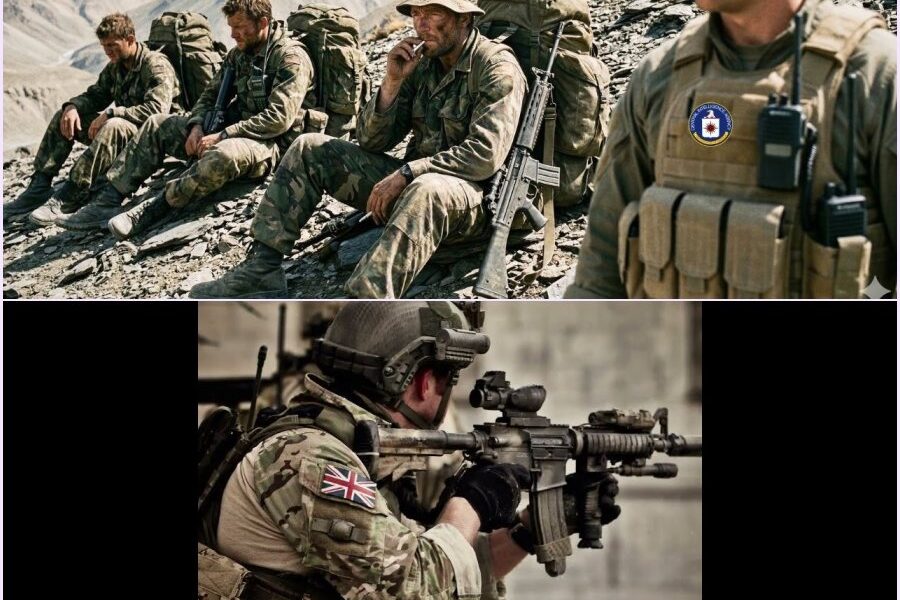

CIA Officers Could Not Believe What British SAS Did in Afghan Mountains
November 2001, the Hindu Kush Mountains, northern Afghanistan. High above the jagged snowdusted peaks, the hum of American Predator drones and the distant roar of B-52 Strata fortresses signaled a new era of digital warfare, one defined by satellite uplinks and precisiong guided munitions. Yet on the ground, in the deep valleys and ancient passes that had swallowed empires for centuries, the conflict was reverting to its most primal form.
While the world watched the rapid collapse of the Taliban’s urban strongholds, a different kind of war was being waged in the shadows of the high altitude, where the thin air and sub-zero temperatures proved as lethal as any insurgent. It was here that officers of the Central Intelligence Ay’s Special Activities Division, operating under the code name Jawbreaker, encountered a force that seemed to belong to another century.
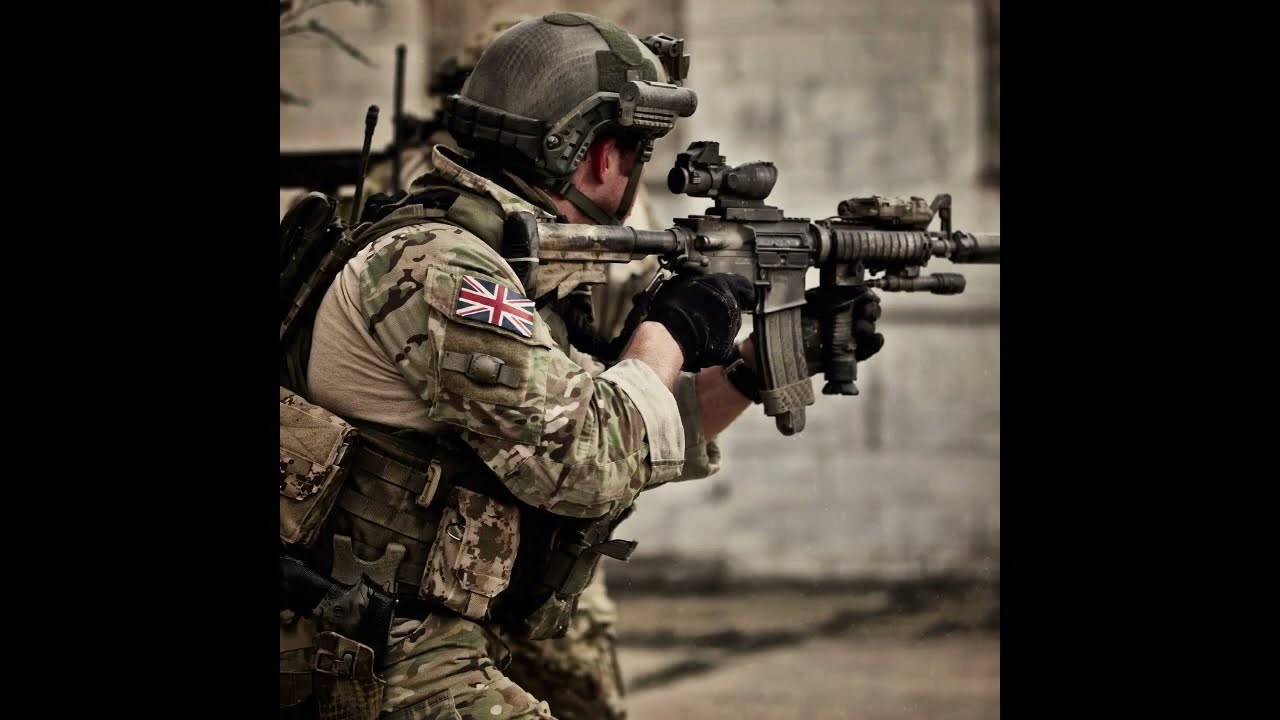
They were the men of the British Special Air Service, or SAS. To the Americans, who were backed by the most sophisticated logistics chain in military history, the arrival of the British patrols was both a relief and a source of profound disbelief. The SAS did not arrive with the heavy footprint or the technological fanfare typically associated with Western intervention.
Instead, they appeared almost out of the mountain mist itself, moving with a rugged, self-sufficient simplicity that stunned their counterparts. The CIA teams, many of whom were veteran field officers and former special operations personnel themselves, were accustomed to the high-tempo equipment heavy doctrine of US special operations forces.
What they saw in the SAS was a stark departure. Small four-man patrols carrying immense physical loads, moving on foot across terrain that was deemed impassible by standard military vehicles. These men were not just surviving in one of the most hostile environments on Earth. They were hunting. The initial British contribution to the war in Afghanistan centered around A&G squadrons of the 22nd SAS regiment was characterized by a specific brand of longrange reconnaissance and direct action that relied more on human endurance and tactical cunning than on
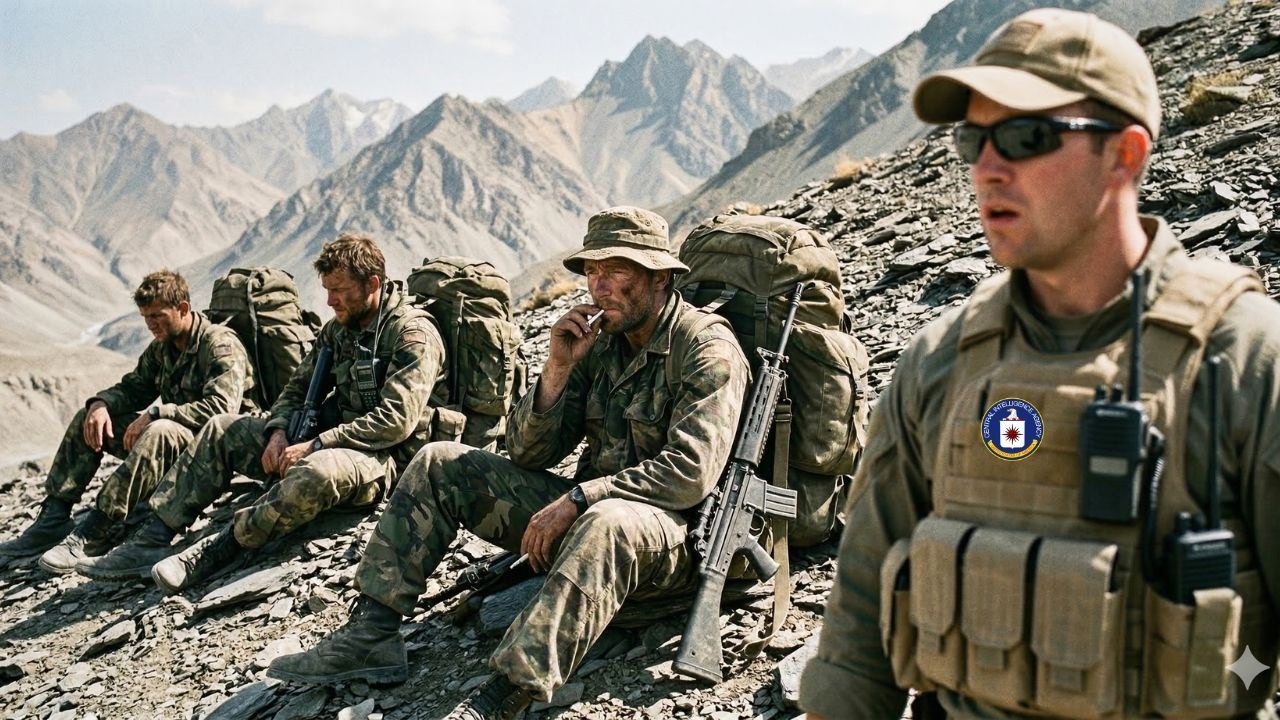
the electronic safety nets the Americans took for granted. As the CIA officers watched these patrols vanish into the darkness of the Afghan night, often without the level of continuous radio contact or immediate medical extraction plans that governed many US operations, a realization began to dawn.
The British were operating on the very edge of the possible, utilizing methods that seemed to push the conventional limits of human physiology and modern military caution. The technological disparity and differing operational philosophies became even more apparent during the preparation for what would become the largest SAS operation since the Second World War, Operation Trent.
In mid- November 2001, the regiment was tasked with neutralizing a high value alka opium processing facility and command center located at the base of the Koi Malik Mountain in the Registan Desert. This facility was not merely a commercial site. It was a hardened fortress protected by an intricate system of trenches and bunkers.
To initiate the mission, an eight-man patrol from G Squadron’s air troop performed a high altitude low opening or halo parachute jump, widely regarded as the regiment’s first halo insertion into hostile territory during the Afghanistan campaign. Dropping from a C130 Hercules at over 20,000 ft into sub-zero temperatures, the men plummeted through the pitch black Afghan night toward a desolate landing zone.
For the CIA officers and other American personnel working alongside them, the risk profile was staggering. While US special operations doctrine typically emphasized having a quick reaction force and dedicated search and rescue assets available within defined time windows, the SAS frequently operated at the margins of these safety nets.
They accepted a level of isolation that many of their American counterparts, constrained by more cautious riskmanagement rules from higher headquarters, often found alarming. This independence was a calculated necessity. By operating without the constant tether of a massive support fleet, the SAS could maintain a negligible signature.
British patrols would often depart and effectively go dark, maintaining radio silence for extended periods to avoid electronic detection by enemy monitoring. CIA paramilitary officers later described with a mixture of respect and disbelief how the SAS viewed the vast, unforgiving mountains as their own private sanctuary.
often preferring to operate alone and without American men minders. This ability to operate off the grid allowed them to approach targets from unexpected directions such as driving modified Land Rovers and quad bikes across hundreds of kilometers of active war zone deep behind enemy lines and far beyond the range of friendly artillery.
The sheer audacity of these longrange movements was a feat of navigation and nerve that fundamentally challenged the established norms of the campaign. To understand why the CIA officers were so taken aback, one must look at the specific operational doctrine that defines the special air service. Since the regiment’s inception in the North African desert, its core philosophy has been built around the fourman patrol.
This small unit size is designed to be the ultimate balance between stealth and capability. in the Afghan mountains. This meant that while a standard American special forces a team consisted of 12 men with a significant logistical tale, the SAS were operating in tiny self-contained cells that left almost no thermal or physical footprint for the enemy to track.
The cornerstone of this self-sufficiency was the Bergen, the iconic British military rucksack. For the patrols operating in the Hindu Kush, these packs often weighed between 50 and 60 kg or roughly 130 lbs. Inside was everything a man needed to survive and fight for weeks without resupply. Ammunition, high calorie rations, cold weather sleeping gear, and the critical communications equipment required to call in air strikes.
To the CIA teams at Bram or in the northern valleys, the sight of men carrying a massive portion of their own body weight up sheer shale slopes at altitudes exceeding 3,000 meters was nearly incomprehensible. This was not the waddle of an overburdened infantryman, but a tactical slow motion ascent through thinning air where every step was a calculated effort of will.
The Americans observed that the SAS seemed to shun the comforts of the larger base camps, preferring to establish lying up positions or LUPS in the most inhospitable crevices of the peaks. From these frozen vantage points, they conducted what is known in British doctrine as longrange reconnaissance. While the CIA used highresolution satellite imagery and drones to map the Taliban’s movements, the SAS provided the ground truth that technology could not always capture.
They sat in the snow for days at a time, observing the subtle patterns of life in the villages below, identifying which goat paths were being used to move ammunition and which caves served as command centers. This level of physical endurance allowed them to bypass the natural bottlenecks of the mountain passes, moving through terrain that the Taliban considered a natural fortress, effectively turning the geography of Afghanistan against its defenders.
One of the most striking aspects for the CIA officers was the British approach to human intelligence and situational awareness. In the early stages of the war, the American strategy relied heavily on high altitude surveillance and signals intelligence, intercepting radio transmissions and satellite phone calls. However, the SAS understood that in a culture as ancient and decentralized as that of the Afghan tribes, the most valuable data was often found in the silence.
CIA personnel frequently operating out of more established hubs like the hotel in Kbble or fortified compounds in the north observed both directly and through reports that SAS patrols would often spend weeks completely submerged in the local environment. These fourman teams would integrate themselves into the topography, moving with a ghostlike presence that allowed them to witness the Taliban’s logistics in a way no drone ever could.
They watched the couriers moving on foot between the high altitude kats or fortified farms and they mapped the intricate cave systems of the Tora region by physically scouting the entrances often under the cover of a moonless sky. This closed target reconnaissance was perilous. Being discovered meant facing overwhelming odds with no guarantee of immediate backup.
Yet the SAS treated these risks as standard operating procedure. CIA officers, many of whom were paramilitary veterans, noted that while US forces often moved with a heavy presence to deter attack, the British moved with a deliberate lack of presence to invite observation. This subtle shift in methodology allowed the SAS to identify the specific individuals who held the true power in a valley, the village elders and the mid-level commanders, rather than just the fighters carrying rifles.
By providing this granular level of detail, the SAS gave the CIA’s jawbreaker teams the ground truth necessary to direct the massive weight of American air power with surgical precision. This synergy between British eyes on the ground and American steel in the sky became a defining characteristic of the early mountain campaign.
But it was the sheer physical toll of the British method that remained the primary talking point among the American officers. They saw men returning from the peaks with frostbitten fingers and sunken eyes, having lost significant body weight, yet ready to redeploy after only a few hours of sleep. This relentless pace was not driven by a lack of resources, but by a professional culture that viewed the environment not as an obstacle to be overcome, but as a weapon to be mastered.
The physical toll on the human body during these operations was exacerbated by the logistical isolation of the British units, a factor that deeply unsettled many American observers who were accustomed to the golden hour rule. The US military’s commitment to evacuate a casualty to a surgical facility within roughly 60 minutes whenever possible.
In the high valleys of the Hindu Kush, such a luxury simply did not exist for the SAS. If a man went down with a shattered limb or a gunshot wound, his survival depended entirely on the medical skills of his three teammates and their ability to keep him alive for hours or even days until an extraction could be negotiated through the extreme weather.
British patrols often moved into areas where air support was physically impossible due to density altitude exceeding the performance limits of most helicopters. This was not viewed as recklessness by the SAS, but as a tactical requirement of the unconventional warfare they were tasked to perform.
The Americans noticed that the British medical kits were notably different. While US kits were extensive and heavy, the SAS carried compact, high utility trauma gear focused on prolonged field care. They were prepared to perform minor procedures in the mud or administer potent analesics that allowed a wounded man to continue moving under his own power if necessary.
This grim self-reliance extended to their sustenance. While the Americans were often supplied with MREs that were calorie dense but bulky, the SAS would supplement their rations with local food, sometimes purchasing livestock from villagers to blend into the local economy and avoid leaving discarded plastic packaging that could betray their presence to a savvy insurgent tracker.
This low signature life extended to their hygiene and appearance. While many CIA officers maintained a distinct operator look with tactical gear and modern outdoor apparel, the SAS became almost indistinguishable from the landscape. Their clothes were stained with the gray dust of the mountains, and their equipment was held together with sniper tape and bungee cords.
To the CIA, this wasn’t just a lack of polish. It was the look of a force that had completely surrendered its ego to the environment. The British weren’t trying to conquer Afghanistan. They were trying to inhabit it, moving through the cracks of the conflict to strike at its heart when least expected.
The following section will examine the culmination of these efforts during the intense battles for the mountain strongholds, where the SAS operational philosophy met its ultimate test. The psychological impact of this British presence was perhaps most evident during the chaotic final weeks of the hunt for leadership in the Tora complex.
As American bombers pounded the mountain sides with thousandl payloads, the CIA’s paramilitary officers found themselves relying more and more on the tactical intuition of the SAS teams embedded with them. While the technology of the early 2000s struggled with the deep shadows and jagged geometry of the Afghan peaks, the British patrols utilized a technique they called human terrain mapping.
They didn’t just look for where the enemy was. They predicted where a hunted man would naturally seek refuge based on the ancient survival instincts of mountain warfare. CIA officers remarked that the SAS seemed to have an innate understanding of line of sight and dead ground, the blind spots in the terrain where an insurgent could hide even from advanced thermal sensors.
In one often cited example of this kind of thinking, a British patrol identified likely ventilation points for an underground bunker system simply by studying the way the snow melted in specific unnatural patterns across a ridge. Observations like this, sometimes missed by overhead imagery, could lead directly to the targeting of command nodes that had eluded capture for weeks.
The level of trust that developed was born of shared hardship, but the disbelief remained. The Americans often commented on the British humor that persisted even in the most dire circumstances, a dry stoic wit that served as a psychological shield against the crushing isolation of the high altitude.
It was a professional culture that prioritized the long game. Recognizing that in Afghanistan, speed was often the enemy of sustainability. While other units were focused on rapid capture or kill metrics in the new war, the SAS remained focused on the fundamental task of the scout, to see without being seen and to know the enemy better than they knew themselves.
This mastery of fundamentals, navigation, concealment, and endurance allowed them to dominate a space that many in the American military establishment had initially feared would be a graveyard of empires. By the time the primary phase of the Mountain War drew to a close, the CIA officers who had served alongside the SAS didn’t just believe the stories.
They had become the primary witnesses to a standard of warfare that few others could hope to replicate. The legacy of these early interactions in the Afghan mountains redefined the relationship between the CIA and British special forces for the decades of global conflict that followed. The officers of the Special Activities Division walked away with a profound appreciation for the SAS humanentric approach to warfare.
A method that proved that even in an age of orbital surveillance and drone strikes, the ultimate weapon remains the individual operator’s ability to endure, adapt, and outthink the enemy in the most punishing conditions imaginable. This partnership forged in the frozen peaks of the Hindu Kush became a benchmark for combined unconventional operations.
It was a testament to the fact that while technology can change the speed of war, it is the grit and tactical patience of small elite patrols that ultimately dictate its outcome. If you enjoyed this deep dive into the hidden history of special operations, please like this video and subscribe for more detailed military analysis.
Your support helps us continue uncovering the stories that shaped the modern battlefield.
Note: Some content was generated using AI tools (ChatGPT) and edited by the author for creativity and suitability for historical illustration purposes.