
The HORRORS of the Claymore Mine in Vietnam
2:00 a.m. A flicker of movement in the concertina wire. From his bunker, a lone American soldier squints into the blackness of the Vietnamese jungle. He waits. The air is thick, humid, and impossibly still. Then another sound. A soft metallic scrape. Not a jungle creature. Something else. His heart hammers against his ribs.
His hand tightens around a small plastic device. Out there in the layered darkness sits a gently curved olive drab box on a pair of flimsy legs. A patient, silent killer aimed into the night. But is it still aimed at the enemy? Or has the enemy already come silent as a ghost and turned his own weapon back on him? This was the horror of the M18A1 claymore mine.
To understand the claymore, you have to understand the war it was built for. Vietnam was a conflict without clear front lines where the enemy was seemingly everywhere and nowhere at once. For American forces, one of the greatest challenges was defending static positions, fire bases, airfields, and command posts.
from an enemy that could materialize out of the jungle, attack with shocking violence, and then vanish. The North Vietnamese army in Vietkong were masters of the massed human wave assault and the stealthy sapper attack, both designed to overwhelm defenses through sheer terror and brute force. Traditional weapons were not enough. Grenades had a dangerously short range.
And while machine guns were powerful, they created predictable fields of fire that a disciplined enemy could flank or crawl under. The army needed a new kind of weapon. It had to be something that could deny huge swaths of terrain to an attacker, transforming a vulnerable perimeter into an impassible wall of steel.
It also needed to be portable, something a small patrol could carry deep into enemy territory to set up a devastating ambush in minutes. This need had been brutally demonstrated years earlier. The idea wasn’t born in Vietnam, but in the desperate battles of the Korean War. An inventor named Norman Mloud watched newsreal footage of Chinese human wave attacks overwhelming United Nations positions.
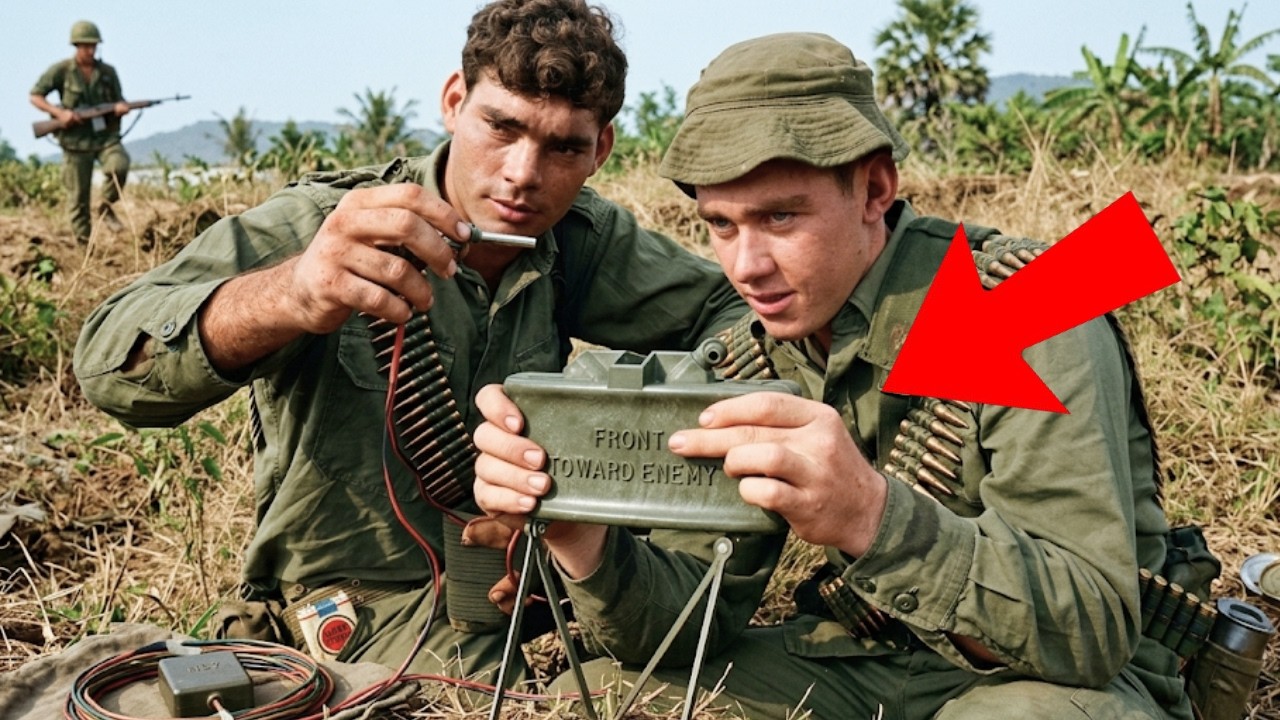
He saw a tactical problem that existing weapons couldn’t solve. Conventional landmines were indiscriminate. What was needed was a directional weapon, a remotely detonated charge that could obliterate a specific area on command. Mloud was inspired by the Misnet Chardan effect, a principle where the force of an explosive could be focused by a solid backing plate.
He envisioned a device that would act not like a buried mine, but like a shotgun the size of a book, firing hundreds of projectiles at once. For a name, he reached back into history. He called it the claymore after the legendary two-handed broadsword of the Scottish Highlanders. A weapon designed to cut a wide path through enemy ranks.
His invention would do the same, but with explosive force and a storm of steel. The design of the M18A1 Claymore was brutally simple and lethally effective. Inside its curved plastic case sat a pound and a half of C4 explosive. Bonded into the face of that C4 was a plate packed with 700 steel ball bearings. When detonated, the C4 charge propelled those 700 steel balls outward in a 60° arc.
They didn’t just fly, they erupted, traveling faster than a high-powered rifle bullet at nearly 4,000 ft per second. They created a lethal curtain of shrapnel that was brutally effective out to 50 m. Within this primary kill zone, the density of the steel was so great that it could shred everything in its path. Like a giant shotgun blast that was 60 yards wide, it could still wound or kill up to 100 m away.
But unlike a typical mine, the claymore was command detonated. A soldier positioned safely in a foxhole could watch an enemy approach. At the perfect moment, a squeeze of the M57 firing device, known universally as the clacker, would send an electrical charge down the wire. This feature was meant to make it a more deliberate weapon, avoiding the indiscriminate slaughter caused by pressure activated landmines.
The entire system, the mine, its spindly legs, the wire, and the clacker, weighed just over 3 12 lb and was packed into a simple canvas bag. It was a portable zone of death. While early prototypes were fielded in the 1950s, the refined M18A1 Claymore saw widespread use in Vietnam, starting in the early 1960s.
By the middle of the decade, it had become a standard issue nightmare for the NVA and Vietkong. Production was ramped up to staggering levels to meet the insatiable demand. They were deployed everywhere. Their primary role was perimeter defense. Sprawling fire bases like Kesan were ringed with hundreds of claymores, often wired together and layered between dense fields of barbed wire.
They were the first line of defense against the dreaded sapper attacks and human wave assaults. For soldiers huddled in their bunkers as an attack began, the rolling thunder of their claymores erupting in the wire was the sound of survival. A violent explosive barrier that tore apart attacking formations and bought critical time for the machine gunners to open fire.
But the claymore was just as deadly on the offense. Small patrols used it as the ultimate ambush weapon. A squad could move silently along a jungle trail, placing multiple claymores to cover the enemy’s expected path. The detonation of the mines would be the terrifying opening act of the ambush, inflicting mass casualties, sewing chaos, and funneling any survivors directly into the waiting guns of the American troops.
Elite units like the Navy Seals and MACVS used the Claymore with lethal artistry, cementing its reputation as an essential tool of jungle warfare. The enemy did not fear it forever. He studied it. He adapted. He sent his best men into the darkness. He moves without a sound. The mud is cool on his skin. He can smell the rain coming. Every inch is a risk.
His fingers probe the ground slowly, deliberately. He finds a trip flare wire first. He follows it with his hands. A soft touch is all it takes. He cuts the wire. No light, no sound. He keeps crawling. 10 m, 20. Then his fingers brush cool plastic. He stops. He does not breathe. His hands know the shape, the gentle curve, the two thin legs.
He traces the raised letters. His fingers find the wire. It leads back toward the bunker, back to the sleeping Americans. He has a choice. He can cut the wire or he can turn the mine around. The NVA and Vietkong were masters of adaptation. They didn’t just endure the Claymore’s effects. They studied its weaknesses and developed chillingly effective counter measures.
They trained specialized sapper units whose sole purpose was to defeat American defenses. These commandos were experts in stealth, learning to crawl through dense minefields and wire obstacles, often under the cover of monsoon rains or the darkest nights. They knew how to spot the thin command wires leading from the mine back to the American fighting positions.
In one veteran’s account, an ambush failed when the enemy walked right into the kill zone, and the clacker didn’t work. After the firefight, they checked the wire and found it had been cleanly cut. The enemy had crawled into their trap, disarmed it, and nearly turned the ambush against them. But their most terrifying tactic was far more direct.
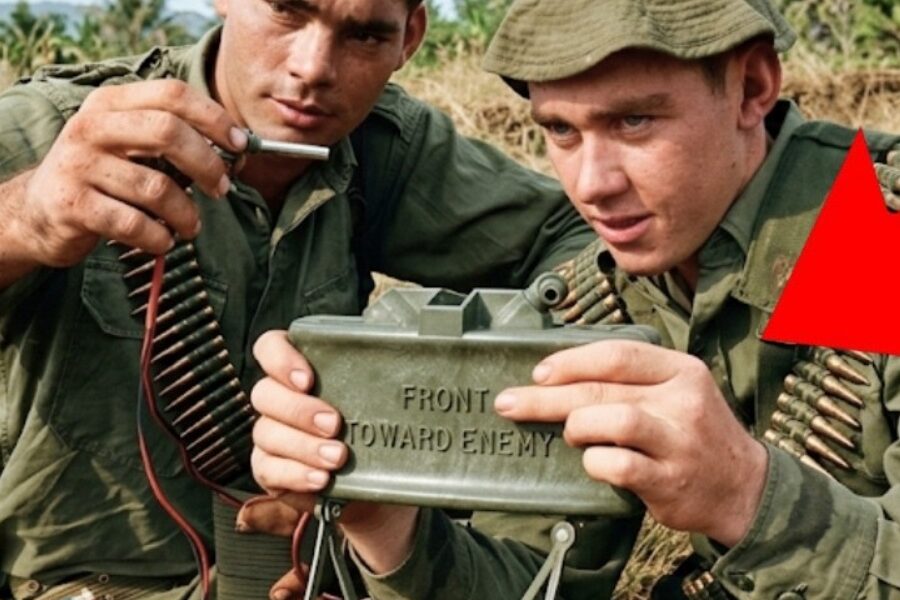
In a move of pure psychological warfare, sappers would crawl right up to a claymore and simply turn it around. The weapon meant to protect a firebase was now aimed directly at its defenders. That simple instruction on the mine, front toward enemy, became a source of deep paranoia. A soldier on guard duty now had to wonder if the defensive line he trusted had been turned against him by an enemy he never saw.
The horror was compounded by the fact that the enemy began using American technology against them, even creating their own direct copy, the DH10, often built by scavenging parts from captured or unexloded American mines. The true horror of the Claymore wasn’t just in its mechanics, but in its deep psychological impact. For the American soldier, it was an object of grim necessity.
Every night on watch, men would perform the ritual of checking their claymores, making sure the connections were good and the facing was correct. They’d stare out into the wire, wondering if a shadow had already come and gone. The clacker became a physical extension of their will. They would sleep with it in their hand or tucked under their helmet.
Holding the M57 firing device was a heavy burden. Your palm would sweat around its hard plastic shell. You would feel the spring tension under the firing handle. In an ambush, your entire world would shrink to the feel of that clacker and the sounds coming from the trail ahead. The decision to press it was monumental. It wasn’t like firing a rifle at a single combatant.
It was the decision to unleash annihilation upon an entire area, to kill on a scale that was both impersonal and horrifically intimate. The click of a clacker that failed to detonate was a moment of absolute heartstoppping terror, turning a perfectly planned ambush into a desperate closearters fight for survival.
But even when it worked, it brought its own trauma. The weapon was so brutally effective that it created scenes of complete carnage that haunted the men who had to witness it. It was a symbol of safety for the soldier behind it and a symbol of brutal terror for anyone in front of it.
And when the enemy turned it around, it became a symbol of utter vulnerability, a reminder that in Vietnam, even your own defenses could become your downfall. The M18A1 Claymore was more than just a mine. It was a weapon that fundamentally changed the tactical reality of the Vietnam War. It allowed small, outnumbered groups of soldiers to hold off much larger forces and gave patrols the power to project incredible force from a deep ambush.
Its legacy is written in the steel that still litters the soil of Southeast Asia and etched into the memories of the soldiers who wielded it and those who faced it. The claymore’s brutally effective design has ensured its place in military arsenals across the globe. It is still in use by the US military and dozens of other nations today.
A lasting and fearsome invention from a brutal war forever waiting in the dark. And somewhere in the jungle, a choice is being made that will determine who lives and who dies before the sun comes
Note: Some content was generated using AI tools (ChatGPT) and edited by the author for creativity and suitability for historical illustration purposes.