The Great British Steel ‘fiasco’: Labour signals end of virgin steel making to meet net zero commitments despite threat to national security amid wars raging in Middle East and Ukraine. c1

The Great British Steel ‘fiasco’: Labour signals end of virgin steel making to meet net zero commitments despite threat to national security amid wars raging in Middle East and Ukraine
The government last night signalled the end of virgin steel making in Britain to meet net zero commitments – despite war raging in the Gulf and the threat from Russia.
The move, part of Labour‘s long-delayed £2.5bn Steel Strategy published today, comes amid national security concerns about losing the ability to produce our own new steel.
And it is despite ministers spending nearly £400m of taxpayers’ cash to keep the country’s last blast furnaces at Scunthorpe steelworks afloat since using emergency legislation to take over management from Chinese owners Jingye last April.
The strategy commits to ‘electric arc furnaces (EAF) as the future of British steelmaking, continuing the shift from blast furnaces to cleaner, EAF-based production using recycled scrap to support net zero’.
But electric arc furnaces cannot produce virgin steel – risking Britain’s national security if there was an urgent requirement to build ships and tanks during a future conflict.
Retired Royal Navy Admiral Lord West said: ‘We’re in a very dangerous and uncertain world and, wherever possible, we need the resilience and capabilities to deal with that – one of those things is the ability to produce virgin steel.
‘People are saying you would be able to buy it wherever but as we’ve found out with Trump and America, you can’t rely on even really old alliances.’
Lord West, former First Sea Lord and a Labour peer, added: ‘We are still, notwithstanding what a lot of people think, a great power with a lot of interests including 14 overseas territories.

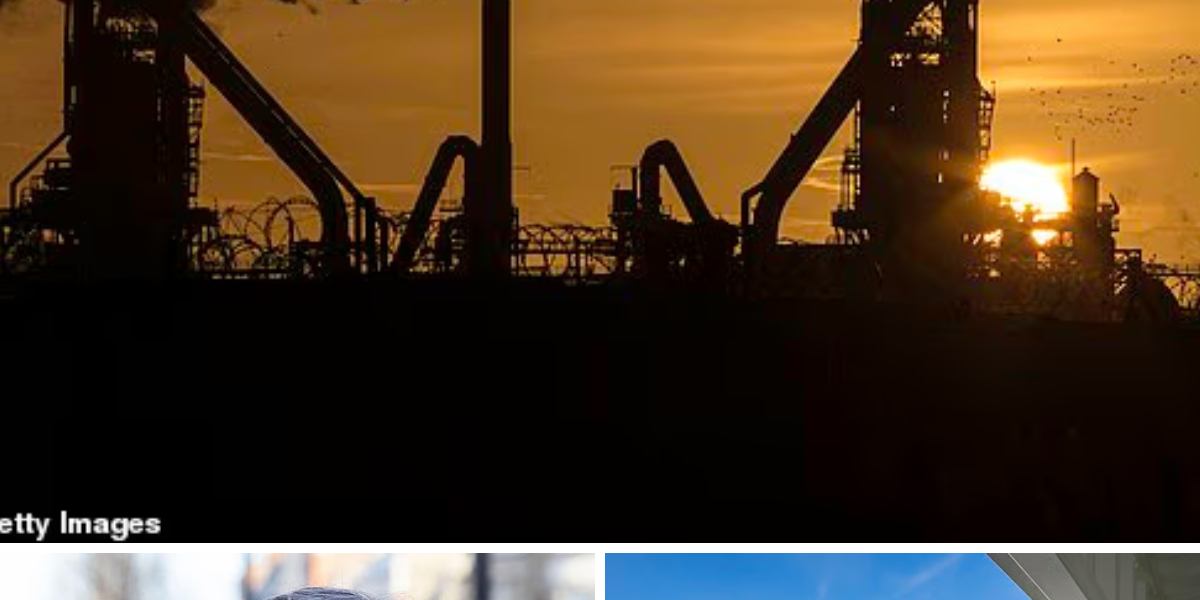
Britain’s last two blast furnaces at Scunthorpe steelworks, which employs 3,200 people

Energy and Net Zero Secretary Ed Miliband has ‘won the battle’, according to Tories
‘It seems to me extraordinary that a country with that clout should not be able to produce virgin steel.
‘I can’t believe America, France, China or Russia would do that. We would be very silly to just throw that away.’
Opposition Tories branded the situation a ‘fiasco’ and a surrender to energy secretary Ed Miliband’s Net Zero demands.
And a senior Labour MP called on the government to ‘seriously consider’ investing in new methods of virgin steel production such as through use of hydrogen to ensure ‘we can still meet the objective of producing virgin steel’.
Business and Trade Secretary Peter Kyle launched the Steel Strategy on a visit to Port Talbot, South Wales, yesterday – where a new electric arc furnace is being created with a near-identical three million ton capacity to Scunthorpe.
The development by Indian-owned Tata Steel is being part-funded by £500m of taxpayer cash committed under the Conservatives.
The steel strategy includes measures Britain’s beleaguered industry has been crying out for, including 50pc tariffs on imports above new quota limits from July 1 – to tackle a glut of cheap imported steel stemming from China.
There will also be a target for ‘up to 50pc of steel used in Britain to be made in Britain‘, up from 30pc at present, and plans to ensure UK firms can make steel required for billions of pounds of new wind turbines.

Admiral Lord West believes Britain would be ‘very silly’ to throw away virgin steelmaking ability
The government insisted its measures would help restore the viability of the industry, ‘preserving vital steel production for critical national infrastructure and defence’.
But advance details of the Strategy made no mention of tackling the highest commercial energy prices in Europe – further hit by oil price hikes following the US-Israel war with Iran.
There was also no mention of reforming green taxes, which has led to criticism of the government subsidising the industry ‘with one hand and taking back with the other’.
Andrew Griffith, Tory shadow Business and Trade Secretary, said: ‘The whole thing to me is a fiasco. It sounds to me like closure for the blast furnaces in Scunthorpe and that Ed Miliband is winning the battle.
‘We seem no further forward in terms of a coherent strategy to protect virgin steelmaking for our national security.’
Labour grandee Clive Betts MP, vice chairman of the Public Accounts Committee, said he and colleagues would be ‘closely scrutinising’ the cost of intervention at Scunthorpe.
He added: ‘Are they (ministers) seriously considering alternatives for virgin steelmaking?
‘There are newer techniques to producing virgin steel without using blast furnaces including using hydrogen.
‘That would be a more modern, more environmentally-friendly way to deliver on the objective that we can still produce virgin steel’.
Mr Betts said the current level of imports – which included £50m of steel bought abroad last year for government contracts which could have been produced in Britain – was ‘clearly ridiculous’.
Referring to Speciality Steel UK’s Rotherham electric arc furnace – sat idle since the summer of 2024 despite the firm being taken under taxpayer control in addition to British Steel after the collapse of owner Liberty – he called for public procurement to ‘ensure British steel is bought where possible… bringing back into use steel plants lying idle’.
A source close to British Steel said plans are still under consideration to replace blast furnaces at Scunthorpe with a new electric arc furnace.
Leading industrialist Sir Andrew Cook – who has spoken out strongly against axing blast furnaces – said the government was right to restrict cheap imports and protect the domestic industry, supporting 34,000 jobs.
He said: ‘The Government’s measures are a recognition of the need to defend the industry from distortions in global markets.’
Mr Kyle said the Steel Strategy aims to ‘secure the industry’s role in supporting vital UK sectors like infrastructure, defence and clean energy‘.
Up to £2.5 billion funding will be made available through loans and grants.
Mr Kyle said he believes there is a ‘bright future’ for steel – adding: ‘Steel is going to be essential as we invest in our defence and infrastructure, and renew our infrastructure.’
He added: ‘Making steel in the UK is vital for national security, critical infrastructure and the wider economy.
‘Steel-making is a cornerstone of our modern industrial policy that deliberately focuses support for key industries, technologies, and strategically important sectors.
‘With this strategy we are closing the decades-long chapter of destructive de-industrialisation and committing instead to strengthening and sustaining Britain as a steel-making nation.’
The government also said it would work to ‘secure a sustainable supply of scrap metal for UK steelmakers’ as well as taking ‘action on workforce needs and innovation to boost productivity and competitiveness’.

Business and Trade Secretary Peter Kyle at Tata Steel’s Port Talbot site in Wales yesterday
‘Transition’ for blast furnaces but claim of industry’s ‘bright future’
Business and Trade Secretary Peter Kyle said Britain’s steel industry had a ‘bright future’ but he gave no guarantees on long-term viability of British Steel’s two blast furnaces in Scunthorpe.
He said: ‘We are going to need a lot of different types of products going forward. We are going to need predominantly green steel, an area where we can lead the world and there is global demand for it.
‘This is what the sector is telling us they need. The breadth of the steel sector needs support. What you are seeing today is a Government that matches the ambition that the steel sector has for itself.
‘So there is a bright future for steel in all of its glorious diversities.’
Mr Kyle said steel being produced by blast furnaces would continue until the companies ‘decide to transition’.
He said the Government was ‘in discussions’ over claims it could cost £1.5bn of taxpayers’ money by 2028 to keep Scunthorpe’s furnaces going.
The minister met with executives of Tata Steel and trade unions at the giant Port Talbot steelworks in South Wales which once employed 25,000 people. Its current workforce is 2,500, after the shut-down of blast furnaces in 2024.
He said: ‘It was really productive, really forward facing. Both the unions and Tata are really excited about the Steel Strategy.
‘The industry has been known for decline for the last 50 years. I’m not here to manage or mitigate deindustrialisation.
‘Steel is going to be essential as we invest in our defence and infrastructure, and renew our infrastructure for a new generation, whether that be for trains and some of the new runways we’ll be building.
‘So there will be huge demand for steel of that quantity but also demand for specialist new products.’
Mr Kyle was speaking from a viewing area over the site of what will become the largest electric arc furnace in the world.
The plant will bring in 70,000 tons of scrap steel by rail each week to feed the furnace and turn out high-quality steel.
A Tata spokesman said it could be described as a huge recycling operation exploiting a limitless supply of steel from within the UK.
The Secretary of State said: ‘One of the things that has struck me is how much Artificial Intelligence is being integrated into the design, productivity efficiency, productivity and distribution of steel.
‘People don’t look at the steel industry and think about AI technology and innovation but increasingly that’s how it’s going to be seen, particularly as it evolves into one that is more modern and less of the heavy infrastructure you’ve seen in the past.’
Mr Kyle said the Government would ‘look at all ways’ to meet the new 50 per cent target, domestically and cost effectively.
He said: ‘We have a commitment to use British supply wherever possible and practicable. We are going to be doubling down on that.
‘I want to make sure that the Government aligns with the interests of British industry and come together to support the British economy as much as possible. Wherever there is opportunity we will be exploring it.’
Mr Kyle said the Government was ‘ambitious’ in its plan to boost domestic production to meet up to 50 per cent of the country’s domestic demand for steel.
He said: ‘I and my colleagues across government are going to be straining at the bit to find opportunities where we can fulfil that target and go even further. Not just steel but a whole variety of different products and services.’