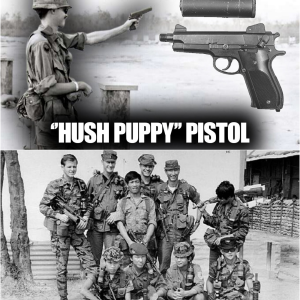

The Vietnam Pistol That’s STILL Classified 50 Years Later
In 1966, Navy Seals asked the Pentagon for permission to build a suppressed pistol and senior military officials said no. Their reasoning, suppressed weapons were considered assassin tools, too ungentlemanly for American soldiers. So the SEALs lied. They told Washington the weapon was for shooting dogs.
Guard dogs and geese in Vietnamese villages would bark when American commandos approached. The SEALs claimed they needed a quiet way to eliminate these early warning systems. The Pentagon approved it and the weapon they built went on to be used for far more than silencing dogs. Only about 120 were ever made.
Its combat record is still classified, and most of the men who carried it were told the United States would deny their existence if they were ever captured. This is the story of the Hush Puppy. To understand why this pistol mattered, you need to understand who was using it. On January 24th, 1964, the US military created one of its most classified units of the entire Cold War.
They called it the Military Assistance Command, Vietnam, Studies and Observations Group, M A C VVS OG. The name was deliberately boring. Studies and observations. Sounds like a group of professors conducting research. It was nothing of the sort. M A CVs OG consisted of about 2,000 American operators, mostly Army Green Berets, alongside Navy Seals, Air Force commandos, and CIA personnel.
They worked with roughly 8,000 indigenous fighters, including Montineyard tribesmen, and Vietnamese allies, running missions the United States officially denied were happening. These small teams, often just 6 to 12 men, crossed into Laos, Cambodia, and North Vietnam to gather intelligence on the Ho Chi Min Trail, snatch prisoners, plant sensors, and conduct sabotage operations.
They were outnumbered on every mission, sometimes by thousands. The casualty rate exceeded 100%. In 1968, every SOG reconnaissance man was wounded at least once. Roughly half were killed. SOG veteran John Striker Meer describes arriving at his first forward operating base and being told to sign a 20-year secrecy agreement.
They couldn’t talk about what they did, where they went, or even that their unit existed. If captured, the United States would deny all knowledge of their activities. Macy Visog didn’t receive its presidential unit citation until April 4th, 2001, nearly 30 years after the unit was deactivated. As three tour SOG veteran Major John Plaster put it at the ceremony, everything we were doing in the old days was denied.
We accepted that. That’s part of the cost of doing classified black operations. Even our existence was denied. These were the men who needed a weapon that could eliminate a sentry without alerting the thousand enemy troops camped nearby. They needed a pistol that was essentially silent. And in 1966, they finally got one.
Here’s where the story gets interesting. By 1966, Navy Seals were deploying to Vietnam and desperately needed a suppressed sidearm. The only options available were terrible. The World War II era highstandard HDM was chambered in22 long rifle. Quiet, sure, but 22 was barely adequate for dogs, let alone enemy soldiers.
The suppressed M3A1 grease gun worked, but weighed over 11 lb. That’s impossibly heavy for teams swimming to shore on covert infiltrations. But there was a problem beyond the equipment. Senior military officials and politicians viewed suppressed weapons as quote just weapons for assassins. Requests for a purpose-built silenced pistol met institutional resistance.
So the SEALs found a workaround. A member of SEAL team 2 later explained it to historian Kevin Dockery. When we originally asked for a suppressed pistol, the powers that be did not want it called a silencer, we were asked what we wanted it for. Since the idea of killing men with a suppressed handgun was somehow unsportsmanlike, we told them that the weapon was wanted to shoot dogs.
Every Vietkong village had some dogs hanging around that would sometimes bark when we approached. Since the weapon was intended to silence dogs, and any other vermin who happened to get in front of it, the pistol was named the Hush Puppy. This wasn’t entirely fiction. Guard dogs and geese did serve as early warning systems, but the cover story was carefully crafted to overcome bureaucratic resistance to what was in reality being designed for a much broader purpose.
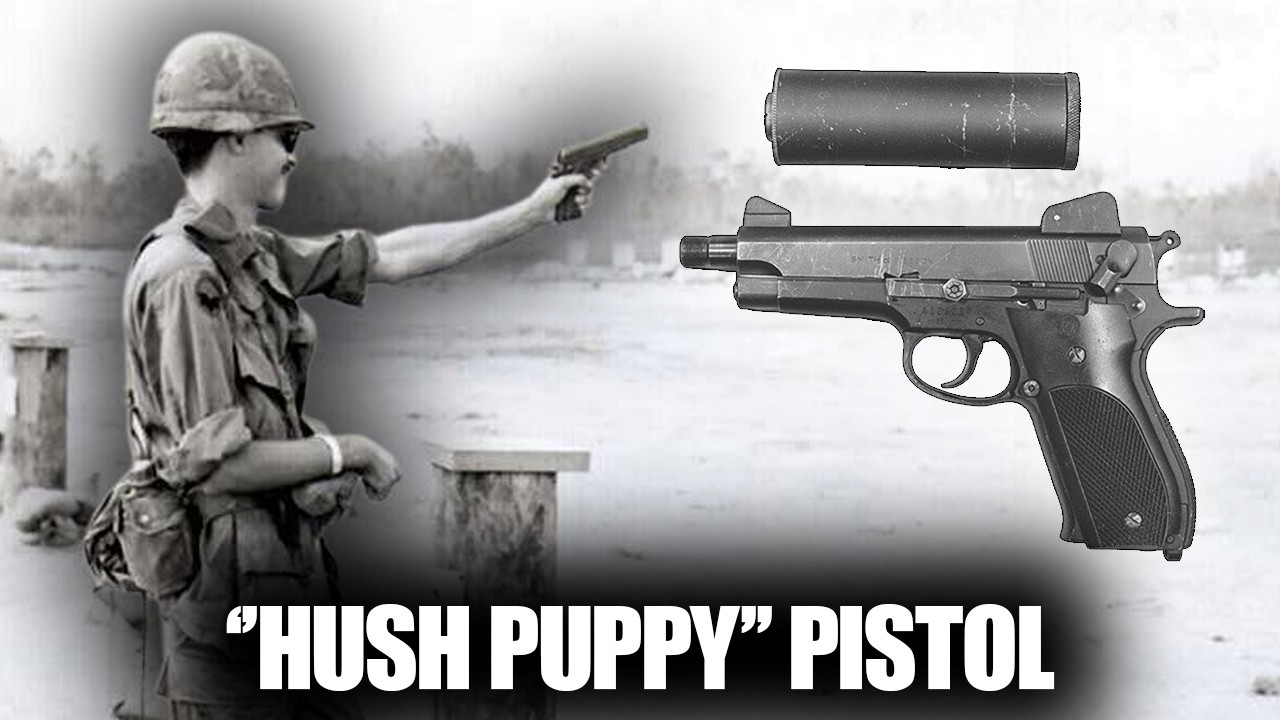
In fiscal year 1966, the Naval Surface Ordinance Center at White Oak, Maryland began development. Smith and Wesson was contracted to modify their model 39 semi-automatic pistol. By late 1967, the first hush puppies reached seal platoon in Vietnam. The Mark 22 Mod 0 wasn’t just a Smith and Wesson Model 39 with a suppressor screwed on.
It was fundamentally re-engineered for a specific purpose. Smith and Wesson made at least 11 documented modifications to transform a standard service pistol into a covert operations tool capable of functioning after submersion to 200 ft. The barrel was extended from 4 in to 5 in and threaded at the muzzle to accept the Mark III Mod 0 suppressor.
This suppressor was 5 in long, weighed just 8 o, and was made of black anodized aluminum. Inside the suppressor used something called wipes. Four elastimir discs, each about a/4 in thick with an X scored into the center. When a bullet passed through, the wipes deformed to let it pass, then sealed shut behind it, trapping the combustion gases.
The result was devastating sound reduction, but the wipes degraded with each shot. After about 24 rounds, the insert needed replacement. The pistol’s most innovative feature was its slide lock mechanism. A special latch with raised triangular tips engaged matching notches in the slide, physically locking it closed. Here’s why that mattered.
A suppressed firearm produces noise from three sources. The muzzle blast, the supersonic crack of the bullet breaking the sound barrier, and the mechanical clatter of the slide cycling back and forth. The Mark III suppressor handled the muzzle blast. purpose-built Mark 144 Mod0 subsonic ammunition with a heavy 158 grain bullet traveling at only 965 ft pers eliminated the supersonic crack and the slide lock eliminated the mechanical noise with the slide locked and subsonic ammunition loaded the weapon produced approximately
129 dB of peak sound pressure the official Navsea manual described it as essentially inaudible. The trade-off was significant. With the slide locked, the Mark 22 became a manual singleshot repeater. After each trigger pull, the operator had to unlock the slide, rack it manually, and re-engage the lock before firing again.
Speed was sacrificed for total silence. The complete system was packaged as the Mark 23 Mod0 kit, pistol, suppressor, waterproofing plugs, spare parts, extra magazine, and grease, all nested in styrofoam. Inside, a steel ammunition can, a companion Mark 26 Mod0, accessory kit provided, field resupply, 24 rounds of subsonic ammunition, and one replacement suppressor insert.
The specific combat exploits of the Mark 22 Hush Puppuppy remain among the most closely guarded secrets of the Vietnam War. Multiple sources confirm this directly. guns.com states plainly, “While the actual exploits of the Mark 22 Hushpuppy are still classified, no declassified afteraction reports naming the weapon in a specific operation have surfaced in public literature, but veteran accounts paint a picture of how it was used.
>> Did you ever use any like hush puppy?” >> Oh, all the time. A dog killing dog killing things or 22 22 silencers, dogs and geese. That’s what they used all the time for century kind of things, you know. And you know, if you had to, you had to. You know, geese were hard to [ __ ] kill. I mean, >> why would you shoot the geese? >> Cuz they would be quacking.
>> Yeah. >> You know, that would be And yeah, you’d have to put them down fast cuz they’d be quacking and alerting people about what was going on, you know. Same with dogs. Dogs were the same thing. Besides being dinner, dogs would alert you to what was going on. >> Master Chief Kirby Horl served with the SEALs from 1968 to 2014.
He spent part of his Vietnam tour in the Phoenix program, a controversial CIA sponsored effort to identify and neutralize Vietkong leadership. He described his standard loadout to coffee or dye magazine, a Stoner 63 machine gun with 1,00 rounds, concussion grenades, at least two smoke grenades, a knife, and a hush puppy, suppressed pistol to silence sentry dogs and geese.
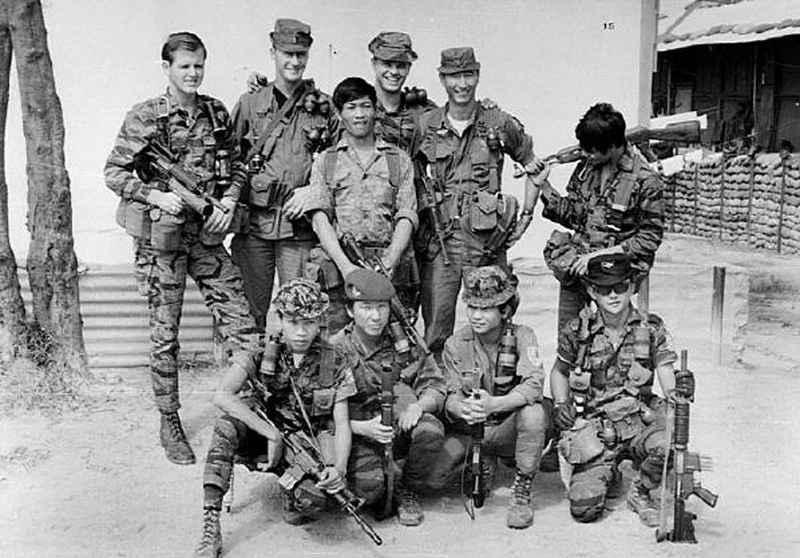
We didn’t have body armor. Our body armor was a t-shirt with a bullseye on it. So that’s the reason why everybody learned to shoot straight and fast because you didn’t want them to ever have the opportunity to put one of those rounds in you. Horell’s teams often wore black pajamas to pass as Vietnamese fishermen in the Mong Delta.
Sometimes just two Americans and two South Vietnamese allies in a sampling into enemy territory. The tactical applications extended well beyond dogs. S OG and SEAL teams operating deep behind enemy lines needed to silently remove sentries guarding trail junctions, camps, [music] and installations. Prisoner snatch operations demanded silent approach.
Wiretapping missions along the Hochi Min trail required eliminating guards without alerting surrounding forces. Seal Team 2 alone eventually held 45 hush puppies in its inventory. Each deploying platoon received at least one Mark 22. Military historian Matthew Moss reports that hush puppies were used by SEAL teams who penetrated into North Vietnamese waters and targeted both North Vietnamese and allegedly Chinese targets, but the details of these operations remain classified.
The Hush Puppy remained in Navy Seal armories for nearly three decades after production ended in the early 1970s. The aging pistols developed cracks in the slide’s locking notches from extended use. With Smith and Wesson having moved on and spare parts unavailable, the seals eventually transitioned to new weapons.
In the early 1990s, the Mark 22 was formally replaced by the Heckler and Ko Mark 23 SOCOM pistol, a weapon explicitly designed as its successor through the Special Operations Commands Offensive Handgun Weapon System Program. But the Hush Puppy’s influence extends far beyond its direct successors. Suppressor height sights, raised iron sights designed to clear the diameter of an attached suppressor, were pioneered on the Hush Puppy.
Today, there are standard factory option on virtually every tactical handgun. Threaded barrels for detachable suppressor attachment became the universal standard. The concept of purpose-built subsonic ammunition matched to a specific weapon system traces directly to the Mark 144 program. Perhaps surprisingly, the Hush Puppy’s DNA even reached the civilian market.
After completing the MK22 contract, Smith and Wesson commercially marketed the double stack magazine design as the model 59. That pistol launched the entire 1 to nine category of high-capacity 9mm handguns that dominated American law enforcement and civilian markets through the 1980s and 1990s. Today, only about two original Mark 22s exist in private collections.
Most reside in military museums, including the Hampton Roads Naval Museum in Norfolk, Virginia, where a Mark 22 Mod Zero is displayed as part of the 10,000day War at Sea exhibit. The Hush Puppy occupies a unique position in military history. A bridge between the crude, suppressed weapons of World War II and the sophisticated systems fielded by modern special operations forces.
Its real significance lies not in the roughly 120 pistols manufactured, but in the systems thinking approach it introduced. Purpose-built pistol, matched suppressor, dedicated subsonic ammunition, field replaceable components, all packaged as an integrated kit. Every suppressor ready pistol sold today carries the Hush Puppies DNA.
The weapon was born from a cover story about silencing dogs carried into the most dangerous covert operations of the Vietnam War by men whose very existence was denied and left a technical legacy that reshaped handgun design for the next half century. The fact that its combat record remains classified only adds to the mystique of a weapon that was by design never meant to be heard.
If you want to learn more about the secret operations of Vietnam, check out the video on screen
War is rarely a quiet affair. It is conventionally defined by the deafening roar of artillery, the relentless chatter of heavy machine guns, and the concussive, earth-shattering force of explosives. Yet, in the deepest, most shadowed corners of the Vietnam War, silence was not just a fleeting luxury—it was a matter of absolute, uncompromising survival. In a conflict defined by dense jungle canopies, hidden tunnel networks, and unconventional guerrilla warfare, the ability to operate undetected was the ultimate weapon.
In 1966, the United States Navy SEALs approached the Pentagon with a straightforward but critical request: they needed permission to build a purpose-built, suppressed pistol for their covert operations. Senior military officials, entrenched in traditional combat doctrines, issued a flat denial. Their reasoning was strictly rooted in a bygone era of military chivalry. To the top brass in Washington, suppressed weapons were viewed with deep distaste. They were considered “assassin tools”—weapons that were entirely too ungentlemanly and unsportsmanlike for honorable American soldiers to carry into battle.
Faced with an institutional wall of resistance and the very real prospect of dying in the jungles of Southeast Asia because of bureaucratic stubbornness, the SEALs realized that telling the truth was no longer an option. So, they lied.
They crafted a brilliant, seemingly innocent cover story for Washington. They told the Pentagon that the suppressed weapon was not intended for hunting enemy combatants, but rather for shooting stray animals. Guard dogs and flocks of geese in rural Vietnamese villages would frequently bark and quack when American commandos approached under the cover of darkness. These animals acted as a highly effective, organic early warning system for the Viet Cong and North Vietnamese Army. The SEALs argued that they desperately needed a quiet, localized way to eliminate these noisy animals without waking up an entire enemy battalion.
The Pentagon, finding this explanation acceptable and far less morally objectionable than state-sponsored assassinations, approved the request. The weapon they subsequently built—dubbed the “Hush Puppy”—went on to be used for far more than just silencing dogs. Only about 120 of these highly specialized pistols were ever manufactured. Today, more than half a century after the fall of Saigon, the Hush Puppy’s official combat record remains strictly classified. Most of the men who carried it were sworn to absolute secrecy, told that the United States government would categorically deny their very existence if they were ever captured. This is the remarkable, shadowy history of the Mark 22 Mod 0 Hush Puppy.
The Ghosts of the Jungle: Understanding MACV-SOG
To truly comprehend why the Hush Puppy mattered so profoundly, one must first understand the incredibly unique breed of warriors who required it. On January 24, 1964, the United States military quietly established one of its most highly classified and fiercely guarded units of the entire Cold War era. They named it the Military Assistance Command, Vietnam – Studies and Observations Group.
To the uninitiated, the acronym MACV-SOG sounded utterly mundane. The phrase “Studies and Observations” was a masterclass in bureaucratic camouflage, deliberately designed to sound like a harmless collective of academic professors conducting geographical or sociological research. In reality, it was anything but.
MACV-SOG was a premier, top-tier special operations force consisting of approximately 2,000 elite American operators. The ranks were primarily filled by battle-hardened Army Green Berets, working shoulder-to-shoulder with Navy SEALs, Air Force Air Commandos, and operatives from the Central Intelligence Agency (CIA). These highly trained Americans did not fight alone; they worked alongside roughly 8,000 indigenous fighters, including loyal Montagnard tribesmen and South Vietnamese allies. Together, they executed highly dangerous, clandestine missions that the United States government officially denied were even happening.
These teams were shockingly small—often consisting of just six to twelve men in total. Under the cover of profound secrecy, these micro-units routinely crossed international borders into officially “neutral” territories like Laos and Cambodia, as well as pushing deep into hostile North Vietnam. Their mission objectives were as dangerous as they were diverse: gathering vital intelligence on the infamous Ho Chi Minh Trail, snatching enemy prisoners for interrogation, planting seismic and acoustic sensors, calling in devastating airstrikes, and conducting high-risk sabotage operations.
On every single mission, SOG operators were astronomically outnumbered, sometimes by thousands of heavily armed enemy troops. The casualty statistics of MACV-SOG are a sobering testament to the danger of their work. By 1968, the unit’s casualty rate famously exceeded 100 percent. This mathematical anomaly meant that every single SOG reconnaissance man was wounded at least once during his tour of duty, and roughly half of them were killed in action.
The culture of secrecy within the unit was absolute. John Stryker Meyer, a legendary SOG veteran, vividly recalls the reality of arriving at his first Forward Operating Base (FOB). Before he could even unpack his gear, he was forced to sign an ironclad 20-year secrecy agreement. Operators were strictly forbidden from talking about what they did, where their missions took them, or even acknowledging that their unit existed. They operated with the chilling understanding that if they were killed or captured behind enemy lines, the United States would disavow all knowledge of their actions.
The incredible sacrifices of MACV-SOG went unacknowledged for decades. The unit did not receive its Presidential Unit Citation until April 4, 2001—nearly thirty years after it had been deactivated. As Major John Plaster, a legendary three-tour SOG veteran, eloquently stated at the 2001 ceremony: “Everything we were doing in the old days was denied. We accepted that that’s part of the cost of doing classified black operations. Even our existence was denied.”
These were the phantom warriors of Vietnam. These were the men who operated in the absolute extremes of human endurance and danger. And these were the men who desperately needed a weapon capable of eliminating an enemy sentry without alerting the thousand hostile troops camped just over the next ridge. They needed a pistol that was essentially silent. In 1966, through their clever deception, they finally got one.
The Search for Silence: Overcoming Bureaucracy and Physics
By 1966, as Navy SEALs began deploying to the riverine environments of Vietnam in greater numbers, the operational need for a suppressed sidearm transitioned from a theoretical desire to a desperate necessity. However, the existing options in the military’s arsenal were woefully inadequate for the realities of modern special warfare.
The first option was the World War II-era High Standard HDM. Chambered in .22 Long Rifle, the HDM was undeniably quiet. However, a .22 caliber bullet lacked the necessary stopping power. It was barely adequate for putting down a large, aggressive guard dog, let alone a determined enemy soldier hopped up on adrenaline. The second option was the suppressed M3A1 “Grease Gun.” While chambered in the hard-hitting .45 ACP and highly effective, the Grease Gun weighed over 11 pounds. For SEAL teams tasked with swimming miles to shore on covert amphibious infiltrations, lugging an 11-pound hunk of steel through the mud and water was a logistical nightmare.
Compounding the lack of suitable equipment was the moralistic posturing of politicians and military leaders who viewed suppressed weapons as fundamentally “unsportsmanlike.” A member of SEAL Team 2, speaking years later to military historian Kevin Dockery, perfectly summarized the workaround: “When we originally asked for a suppressed pistol, the powers that be did not want it called a silencer… we told them that the weapon was wanted to shoot dogs. Every Viet Cong village had some dogs hanging around that would sometimes bark when we approached. Since the weapon was intended to silence dogs and any other vermin who happened to get in front of it, the pistol was named the Hush Puppy.”
While the cover story was a carefully crafted bureaucratic maneuver, it wasn’t entirely a work of fiction. Dogs and geese absolutely did serve as vital early warning systems for the enemy. But the true genius of the lie was how it neatly bypassed institutional resistance, greenlighting the development of a weapon that was destined for a much broader, much deadlier purpose.
Engineering the Mark 22 Mod 0: A Masterpiece of Covert Design
With funding approved in fiscal year 1966, the Naval Surface Ordnance Center in White Oak, Maryland, initiated development. They contracted the renowned American firearms manufacturer Smith & Wesson to serve as the foundation for the project. Smith & Wesson chose to modify their existing Model 39 semi-automatic pistol, a reliable 9mm handgun. By late 1967, the first batches of the newly minted “Hush Puppies” began reaching SEAL platoons in the jungles and waterways of Vietnam.
What Smith & Wesson delivered—officially designated as the Mark 22 Mod 0—was not simply a standard Model 39 with a metal tube screwed onto the end. It was a fundamentally re-engineered piece of tactical hardware, optimized for the harshest environments on earth. Smith & Wesson implemented at least 11 heavily documented modifications to transform the standard service pistol into an elite covert operations tool. Crucially for the SEALs, the weapon was heavily modified to be completely submersible, capable of functioning flawlessly even after being dragged down to depths of 200 feet in corrosive saltwater.
The engineering modifications were extensive. The pistol’s barrel was extended from its standard 4 inches to 5 inches and meticulously threaded at the muzzle to accept the proprietary Mark 3 Mod 0 suppressor. This suppressor was an engineering marvel in its own right. Measuring 5 inches in length and weighing a mere 8 ounces, it was constructed from lightweight, black anodized aluminum.
Inside the suppressor, engineers utilized a technology known as “wipes.” These were four elastomer (rubber-like) discs, each about a quarter-inch thick, with an ‘X’ precisely scored into the center of each disc. When the weapon was fired, the bullet pushed through the wipes, which temporarily deformed to let the projectile pass. Instantly after the bullet exited, the elastomer material snapped back into place, physically sealing shut and trapping the rapidly expanding combustion gases inside the aluminum tube. The result was a devastating, almost unbelievable reduction in sound. However, this level of silence came with a strict maintenance cost: the wipes degraded rapidly with each passing bullet. After firing approximately 24 rounds, the suppressor insert was destroyed and required complete replacement.
But suppressing the muzzle blast was only one piece of the puzzle. A suppressed firearm produces noise from three distinct sources: the explosive muzzle blast, the supersonic “crack” of the bullet breaking the sound barrier, and the mechanical, metallic clatter of the weapon’s slide cycling back and forth to load the next round.
To solve the issue of the supersonic crack, the military developed purpose-built subsonic ammunition: the Mark 144 Mod 0. This specialized 9mm cartridge featured an unusually heavy 158-grain bullet deliberately downloaded to travel at only 965 feet per second—well below the speed of sound, ensuring no miniature sonic boom would echo through the jungle.
To solve the mechanical clatter, Smith & Wesson engineers introduced the Hush Puppy’s most innovative and defining feature: a slide lock mechanism. They installed a special latch with raised triangular tips that engaged perfectly with matching notches machined directly into the pistol’s slide. When engaged, this latch physically locked the slide closed.
The synergy of these three elements—the wipe-based suppressor, the heavy subsonic ammunition, and the physical slide lock—resulted in a weapon that defied belief. With the slide locked and subsonic rounds loaded, the Mark 22 produced a peak sound pressure of approximately 129 decibels. To put that into perspective, the official Naval Sea Systems Command (NAVSEA) manual described the weapon’s report as “essentially inaudible.”
This ultimate silence, however, required a massive tactical trade-off. With the slide physically locked in place to prevent mechanical noise, the semi-automatic Mark 22 was transformed into a manual, single-shot repeater. After pulling the trigger to eliminate a target, the operator was forced to manually unlock the slide, physically rack it backward to eject the spent casing and load a fresh round, and then re-engage the slide lock before they could fire again. In the life-or-death micro-seconds of a jungle firefight, raw speed was intentionally sacrificed at the altar of total silence.
To support the weapon in the field, the military issued the complete system as the Mark 23 Mod 0 Kit. This highly specialized package included the pistol, the suppressor, waterproofing plugs for maritime operations, spare parts, an extra magazine, and specialized grease, all carefully nested in custom-cut styrofoam and housed inside a rugged steel ammunition can. For sustained operations behind enemy lines, operators carried the companion Mark 26 Mod 0 accessory kit, which provided vital field resupply: exactly 24 rounds of the heavy subsonic ammunition and one replacement suppressor insert.
The Hush Puppy in Action: Whispers in the Dark
Because of the highly classified nature of MACV-SOG and SEAL operations in Vietnam, the specific, documented combat exploits of the Mark 22 Hush Puppy remain among the most closely guarded secrets of the war. As firearms historical database Guns.com plainly states: “While the actual exploits of the Mark 22 Hushpuppy are still classified, no declassified after-action reports naming the weapon in a specific operation have surfaced in public literature.”
However, through the fragmented, oral histories of the veterans who survived, a vivid and terrifying picture emerges of how this weapon was truly utilized. When asked in interviews if they ever used the Hush Puppy, veterans often respond with a casual, “Oh, all the time.”
They used them for the very thing they promised the Pentagon: killing dogs and geese. “Geese were hard to [expletive] kill,” one veteran recounted. “I mean, why would you shoot the geese? Because they would be quacking… and you’d have to put them down fast ’cause they’d be quacking and alerting people about what was going on. Dogs were the same thing. Besides being dinner, dogs would alert you to what was going on.”
But the tactical applications extended drastically beyond localized pest control. Master Chief Kirby Horrell, an operator who served an astonishing career with the SEALs from 1968 all the way to 2014, spent a significant portion of his Vietnam tour operating within the infamous Phoenix Program—a highly controversial, CIA-sponsored initiative explicitly designed to identify, infiltrate, and neutralize the shadow leadership of the Viet Cong.
Speaking to Coffee or Die magazine, Horrell described the terrifying reality of his standard combat loadout: a heavy Stoner 63 machine gun loaded with 1,000 rounds of ammunition, concussive grenades, multiple smoke grenades, a combat knife, and his prized Hush Puppy suppressed pistol. Horrell noted the extreme vulnerability of their operations: “We didn’t have body armor. Our body armor was a t-shirt with a bullseye on it. So that’s the reason why everybody learned to shoot straight and fast, because you didn’t want them to ever have the opportunity to put one of those rounds in you.”
Horrell’s teams operated with terrifying audacity. They frequently donned traditional black pajamas to pass themselves off as local Vietnamese fishermen while navigating the muddy waters of the Mekong Delta. Sometimes, a team consisted of just two Americans and two South Vietnamese allies, slipping silently into enemy strongholds.
In these pitch-black, high-stakes environments, the Hush Puppy was an instrument of surgical precision. SOG and SEAL teams operating miles deep behind enemy lines relied on the Mark 22 to silently remove human sentries guarding vital trail junctions, base camps, and hidden installations. When conducting “prisoner snatch” operations—where the goal was to kidnap a high-ranking enemy officer for interrogation without waking his subordinates—a silent approach was mandatory. Covert wiretapping missions along the sprawling logistics network of the Ho Chi Minh Trail required operators to neutralize roaming guards without ever alerting the thousands of surrounding hostile forces.
The demand for the weapon was immense. SEAL Team 2 alone eventually maintained an inventory of 45 Hush Puppies, ensuring that every single deploying platoon received at least one Mark 22. According to military historian Matthew Moss, Hush Puppies were heavily utilized by SEAL teams who boldly penetrated into sovereign North Vietnamese waters, engaging both North Vietnamese and allegedly Chinese targets. Unsurprisingly, the granular details, casualty counts, and specific locations of these black-ops missions remain buried deep in classified government vaults.
The Legacy of Silence: Shaping the Modern Tactical Era
Despite its limited production run of roughly 120 units, the Hush Puppy remained a staple in Navy SEAL armories for nearly three decades. Long after production officially ended in the early 1970s, the SEALs continued to rely on the Mark 22. Over the years, the intense, repetitive stress of firing the weapon with the slide locked eventually caused the aging pistols to develop hairline cracks in their slide locking notches. With Smith & Wesson having moved on to newer designs and spare parts becoming completely unavailable, the SEALs were finally forced to transition to new weapon systems.
In the early 1990s, the legendary Mark 22 was formally replaced by the Heckler & Koch Mark 23 SOCOM pistol—a massive, modern handgun explicitly designed to be the Hush Puppy’s spiritual and tactical successor through the Special Operations Command’s Offensive Handgun Weapon System Program.
However, the true legacy of the Hush Puppy extends far beyond the HK Mark 23. The engineering forced by the SEALs’ unique requirements in Vietnam fundamentally altered the trajectory of modern handgun design.
Consider the concept of “suppressor-height sights.” Because the Mark 3 suppressor was so thick in diameter, it completely blocked the shooter’s view of the pistol’s standard iron sights. Smith & Wesson was forced to pioneer raised iron sights designed specifically to clear the suppressor’s profile. Today, suppressor-height sights are a standard, heavily demanded factory option on virtually every tactical handgun sold in the world.
The universal adoption of threaded barrels for quick, detachable suppressor mounting was standardized by the Hush Puppy program. Furthermore, the very concept of mass-producing purpose-built, heavy subsonic ammunition perfectly matched to a specific weapon system traces its roots directly back to the Mark 144 ballistics program.
Perhaps most surprisingly, the Hush Puppy’s DNA aggressively penetrated the civilian and law enforcement markets. After concluding the highly classified Mark 22 contract for the Navy, Smith & Wesson executives realized they had engineered a phenomenal double-stack 9mm magazine system. They took this technology and commercially marketed it as the Smith & Wesson Model 59. The Model 59 was a revolutionary success. It single-handedly launched the entire “Wonder Nine” category of high-capacity 9mm handguns that completely dominated American law enforcement and civilian self-defense markets throughout the 1980s and 1990s.
A Secret Still Kept
Today, the physical remnants of this shadowy chapter of military history are incredibly scarce. Of the original ~120 pistols manufactured, it is estimated that only about two original Mark 22s exist in private civilian collections. The vast majority of the surviving models reside behind glass in heavily guarded military museums. Notably, the Hampton Roads Naval Museum in Norfolk, Virginia, proudly displays a Mark 22 Mod 0 as a centerpiece of their “10,000-Day War at Sea” exhibit.
Ultimately, the Hush Puppy occupies a fiercely unique position in the pantheon of military history. It stands as the vital, evolutionary bridge between the crude, improvised suppressed weapons of World War II and the ultra-sophisticated, modular systems fielded by modern Tier 1 special operations forces today.
Its true, lasting significance does not lie in the minuscule number of pistols that were manufactured, nor in the uncounted, officially non-existent enemies it put in the ground. Its significance lies in the holistic, systems-thinking approach it introduced to the world of ballistics. The concept of a purpose-built pistol, perfectly matched to a proprietary suppressor, utilizing dedicated subsonic ammunition, featuring field-replaceable components, and packaged as a completely integrated kit—every single “suppressor-ready” pistol sold on the market today carries the indomitable DNA of the Hush Puppy.
This was a weapon born from a desperate, brilliant lie about silencing dogs and geese. It was carried into the absolute most dangerous, unforgiving covert operations of the Vietnam War by men whose bravery was unrecorded and whose very existence was denied by the nation they served. It left a profound technical legacy that reshaped global handgun design for the next half-century.
The fact that the United States government refuses to declassify its combat record, even 50 years after the fact, only serves to amplify the mystique of the Mark 22 Mod 0. It is the ultimate testament to a weapon that was, by its very design and operational mandate, never meant to be heard.
Note: Some content was generated using AI tools (ChatGPT) and edited by the author for creativity and suitability for historical illustration purposes.