
The $25 Gun That OUTLIVED Every Weapon America Ever Sent to War
September 19th, 1918. A cable arrives at the United States State Department. The message comes from Imperial Germany through the Swiss embassy. It contains a threat so specific, so unusual that it will force America to issue a counter threat within hours, execute German prisoners, or face consequences. The weapon in question, a $25 pump-action shotgun.
The Germans call it inhumane, a violation of the laws of war. They threatened to take down any American soldier found carrying one. Not captured with a rifle, not carrying a pistol, a shotgun. The country that unleashed chlorine gas, mustard gas, and fosgene on the battlefields of Europe, the nation that turned entire valleys into chemical death zones is protesting a hunting weapon.
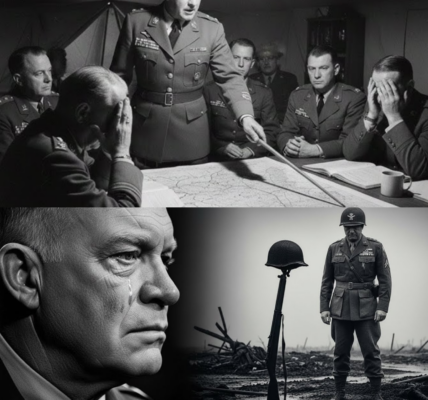
What kind of firearm terrifies an empire that pioneered industrialcale slaughter? France. Summer of 1918. The Western Front has become a graveyard. Four years of mechanized butchery have carved a scar across Europe from the English Channel to Switzerland. Millions intombed in mud. The war has devolved into something medieval.
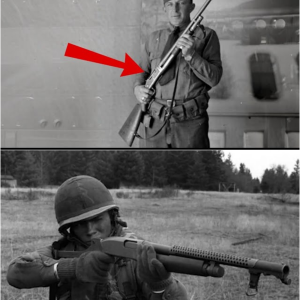
Men fighting with clubs, knives, sharpened shovels in trenches barely wider than a coffin. An American infantryman crouches in a captured German trench. Dawn approaches. He’s part of the scout platoon, first battalion, 26th Infantry Division. In his hands, something the Germans have never seen before. 20 in of cylinder boore barrel, perforated steel heat shield, bayonet lug, six rounds of double ought buckshot, 54 lead balls, each 1/3 of an inch in diameter.
His Springfield rifle leans against the trench wall, too long, too slow, useless at this range. The shotgun in his hands weighs 7 lb and can empty its magazine in under 3 seconds. Each pull of the trigger sends nine projectiles screaming down range at 1,200 ft pers. A German counterattack erupts from the pre-dawn darkness. 20 yards 15 10.
The American doesn’t aim. He points, pumps. The Winchester roars. He doesn’t release the trigger, just works the action. The gun fires every time the bolt slams home. Six shells in two heartbeats. The trench fills with smoke and the wet thud of buckshot hitting flesh. When the sun rises, German officers count their casualties and send a message to Berlin.

The Americans have brought something new to the war, something that changes everything. The crisis began decades earlier, not in Europe, in the Philippines. 1900, the PhilippineAmerican War. American soldiers face mororrow warriors who charge through rifle fire as if bullets mean nothing.
Brass armor, water, buffalo hide, drugs that numb pain and induce religious frenzy. American troops fire center mass with 38 caliber revolvers. Six hits. The warrior keeps coming. 30 ft 20 10. Blade meets throat. The soldier dies with an empty revolver in his hand. The reports pile up. Standard infantry tactics fail against an enemy who won’t stop, won’t slow, won’t retreat. The army needs firepower.
Volume of fire. Something that turns a single soldier into a firing line. They purchase shotguns. Winchester model 1897s pumpaction repeaters designed by John Moses Browning. 20-in barrels. cylinder bore. Five shells in the magazine, one in the chamber. Each shell loaded with buckshot instead of birdshot.
The Moros learn quickly. You can survive rifle fire. You cannot survive six shells of buckshot at 15 ft. The shotgun proves its worth in close combat. But the army doesn’t order more. Doesn’t standardize them. Shotguns remain a specialty weapon. guards, prison details, isolated outposts.
The lesson gets filed away and forgotten until 1917. America declares war on Germany. The reports from France describe something unprecedented. Trench warfare, fighting at arms length in mud-filled ditches, rifles with bayonets over 5t long, impossible to swing in confined spaces. American officers study British and French tactics.
They see doublebarrel shotguns used in raids. Two shots. Break open. Reload. Too slow. Someone remembers the Philippines. The model 1897. Still in production. Still popular with hunters and police departments. The army contacts Winchester. We need 20,000 shotguns. We need them modified for combat. We need them now. The Winchester model 1897 was never supposed to be a weapon of war.
John Moses Browning designed it in the 1890s as an improvement over his earlier model 1893. The difference, a thicker receiver, stronger action, capable of handling the new smokeless powder cartridges that were replacing black powder. The gun became a phenomenon. Farmers bought them for hunting.
Police departments armed their officers with the riot gun variant. Express Company guards carried them on stage coaches. By 1917, over 400,000 had been sold. The design was mature, the manufacturing efficient, the cost remarkably low. $25 for a plain finish model. But the army doesn’t want a hunting shotgun. They want a trench clearing weapon, a 20-in barrel for maneuverability, a heat shield so soldiers can grip a barrel that’s been fired 30 times in rapid succession.
A bayonet mount because even with six shells, you might need 17 in of steel blade. Winchester engineers face a problem. The 12 gauge barrel is too large to fit inside a standard bayonet ring. Every rifle bayonet in the American arsenal is designed for 30 caliber rifle barrels. The solution? Design an adapter that fits over the barrel with the bayonet mounting underneath.
Add a perforated steel heat shield with six rows of ventilation holes. Install sling swivels. Chamber it for two and 3/4 in shells loaded with nine pellets of double buckshot. The modifications take months. The first test weapons reach France in June 1918. 50 shotguns to the 26th Division. 50 to the 42nd. Instructions.
Evaluate for 30 days. Report effectiveness. Document problems. But there’s something Winchester’s engineers discovered during testing. Something they didn’t design. Something that makes the gun unlike any other firearm in the American arsenal. The model 1897 lacks a trigger disconnector, the mechanism that prevents a gun from firing until the trigger is released and pulled again.
On the Winchester, if you hold the trigger down and work the pump, the gun fires the instant the bolt locks home. Slam fire. Empty the magazine in 2 seconds. Six shells, 54 projectiles, fast enough to cut a charging enemy in half before he crosses 10 ft. The War Department designates it the model of 1917 trench gun. Production accelerates.
By September 1918, over 5,000 are in France. By November, 30,000 have been ordered. The cost to the army, approximately $40 per weapon with all modifications and accessories. A young American sergeant kneels in a forward observation post near the Argon Forest. Late September 1918, rain for 3 days straight. Everything soaked.
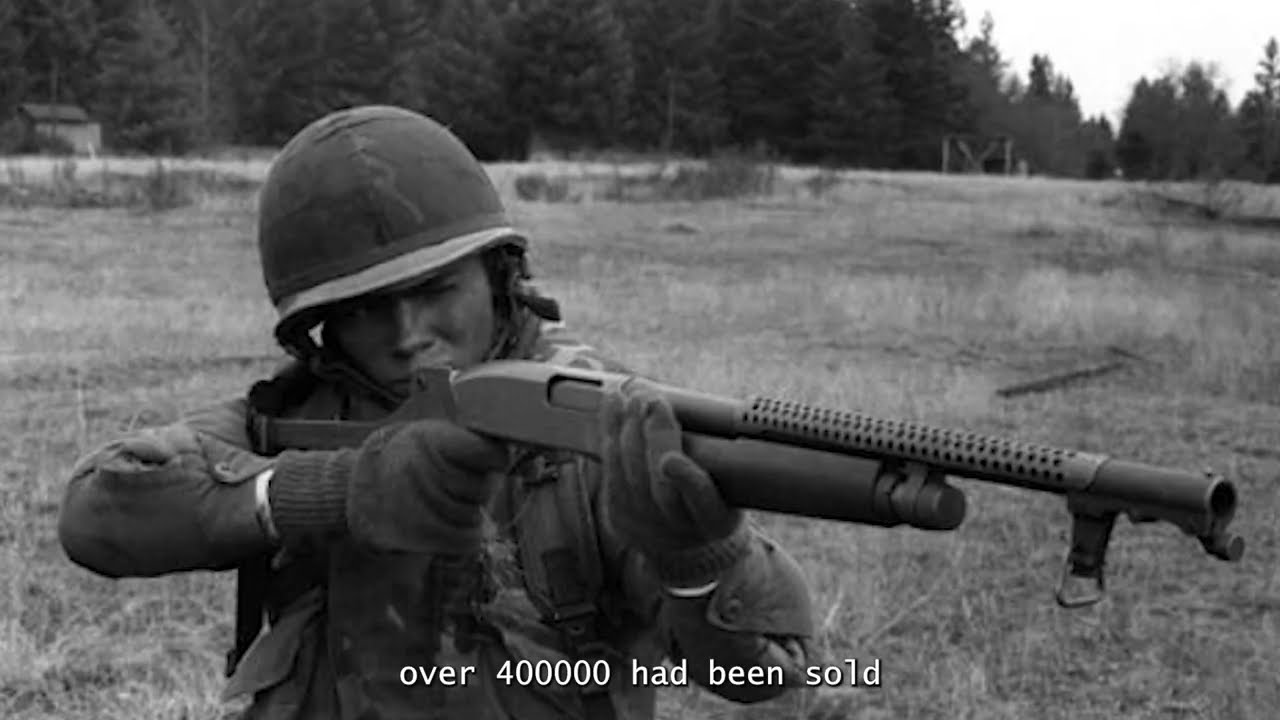
His Springfield is caked in mud. The trench gun across his knees is filthy but functional. German stormtroopers infiltrate the line at 0300. Elite troops trained for trench raids. [snorts] They move silently through the darkness. Grenades, clubs, knives, no rifles, too loud, too slow for this work.
The sergeant hears them before he sees them. Movement in the mud. He raises the Winchester. Doesn’t shoulder it, just points from the hip. The first German appears 10 ft away. The sergeant pulls the trigger and pumps. The shotgun roars. He doesn’t release the trigger, just works the action. 1 2 3 4 5 6. The blast echoes through the trench system.
Muzzle flash illuminates chaos. German soldiers retreat into the darkness, dragging their casualties. When dawn breaks, an American officer counts the results. Nine German soldiers neutralized. 20 yards of trench held by one man with a shotgun. The officer writes in his afteraction report, “The trench gun is the most effective close quarters weapon we possess.
Recommend immediate widespread issue.” But not everyone agrees. Some American soldiers hate the Winchester. The external hammer looks old-fashioned compared to hammerless pump shotguns. The gun is heavy, 7 lb empty, 8 and a half loaded. And there’s a problem with the ammunition. Paper shells. In the wet conditions of French trenches, they swell, jam in the magazine tube, become impossible to chamber even with all your strength.
Winchester solves this with a wartime modification. All brass shells, impervious to moisture, reliable in any weather. The brass shells cost more to manufacture, but eliminate jamming entirely. Some American divisions report nearperfect reliability after switching to brass ammunition. Then there’s the bayonet, 17 in of steel, the same M1917 bayonet used on Enfield rifles.
Some soldiers question the utility. You have six shells of buckshot. Why do you need a blade? But in the chaos of trench fighting, when you’re out of ammunition and the enemy is still coming, 17 in of steel makes the difference between living and dying. The gun earns nicknames. Trench broom, trench sweeper. Some just call it the persuader.
German troops have their own names for it, none complimentary, all fearful. Industrial production during World War I represents a miracle of American manufacturing. Winchester isn’t just building shotguns. They’re producing M1917 Enfield rifles for the expanding American army. They’re making bayonets. They’re fulfilling contracts for the British.
Their factories run 24 hours a day, 7 days a week. Over 30,000 shotguns are procured by the ordinance department before the armistice. Most go to scout platoon. The soldiers who lead raids, probe enemy positions, operate in no man’s land. Some guard German prisoners. Others serve with tank crews as personal protection weapons.
The guns are shipped in batches of 50. Each division receives them with minimal fanfare, no special training manuals, no formal courses, just a basic instruction. Load six shells, pump the action, pull the trigger. If you want rapid fire, hold the trigger down and work the pump as fast as possible. Production costs remain remarkably low.
$40 buys a complete trench gun with heat shield, bayonet adapter, sling, and bayonet. For comparison, a Thompson submachine gun in 1920 costs over $200. The M1911 pistol costs approximately $55 with multiple magazines. The Winchester offers devastating close-range firepower at a fraction of the cost.
By August 1918, shotguns are assigned to the 5th, 26th, 32nd, 35th, 42nd, 77th, and 82nd divisions. Wherever Americans fight in close quarters, the Winchester is there. September 19th, 1918. The German government lodges its formal protest. The message arrives through neutral Switzerland. The language is precise, legalistic, threatening.
The German government protests against the use of shotguns by the American army, and calls attention to the fact that according to the laws of war, every prisoner found to have in his possession such guns or ammunition belonging thereto forfeits his right to treatment as a prisoner of war. Translation: We will execute any American captured with a shotgun.
The protest cites article 23 of the HEG convention of 1907, prohibition of weapons causing unnecessary suffering. The irony is staggering. Germany introduced poison gas to warfare in April 1915 at the second battle of Epris. Chlorine gas, then phosgene, then mustard gas. Hundreds of thousands gassed. Tens of thousands suffer lingering deaths.
lungs destroyed, skin blistered, eyes burned from their sockets. Germany deployed flamethrowers in 1915. Soldiers burned alive in their trenches. Germany pioneered unrestricted submarine warfare, drowning civilians in the Atlantic. And now they protest a hunting shotgun as inhumane. The American response is swift and unambiguous.
Secretary of State Robert Lancing and Acting Judge Advocate General Samuel Ansel draft a reply within 48 hours. The message is clear. The United States government categorically rejects the German protest. The shotgun violates no international law. However, should Germany carry out its threat to execute American prisoners, the United States reserves the right to respond with similar action against German prisoners.
The counter threat works. Germany drops the protest. The war ends 44 days later on November 11th, 1918. No American soldier is executed for carrying a shotgun. No German prisoner faces retaliation, but the protest becomes legend. The weapon so effective that the enemy formally complained. The shotgun that terrified the German army.
The armistice is signed. The war ends. Most weapons are declared surplus and destroyed or stored. The Winchester model 1897. Trench gun packed away in army depots. 30,000 shotguns, some barely used, waiting for the next war. They don’t wait long. December 7th, 1941. Pearl Harbor. America enters World War II.
The military scrambles to arm millions of new soldiers. They pull World War I era Winchesterers from storage. Some are 23 years old. The metal is dulled. The wood is worn, but the guns still function perfectly. Winchester also manufactures new shotguns for the war effort. Over 24,000 are produced between 1942 and 1945.
These differ slightly from World War I models. Takedown receivers instead of solid frames. Four rows of ventilation holes in the heat shield instead of six. But the core design remains unchanged. John Browning’s 1897 pump action now serving in its second world war. Marines in the Pacific theater favor them.
Island hopping campaigns, jungle warfare, cave clearing on Euoima and Okinawa. A Marine corporal describes using one on Pleu. You’d hit a cave entrance with grenades, then go in fast with the shotgun. In those tight spaces, nothing else worked like it. The buckshot would ricochet off cave walls. You didn’t have to see the enemy to neutralize them.
Tank crews keep them as personal defense weapons. Armored vehicle crewmen need compact firearms. If the tank is hit and they bail out, a shotgun is faster to draw than a rifle and more effective at close range than a pistol. American Sherman tanks carry up to five weapons per vehicle. Often three or four are Winchesterers.
The paper shell problem from World War I resurfaces in the Pacific. High humidity, monsoon conditions, shells swell and jam. The solution from 1918 still works. All brass shells. Warehouses full of World War I ammunition are shipped to the Pacific. Some brass shells manufactured in 1918 are fired in combat in 1944. The ammunition performs flawlessly.
1950 Korea, the Forgotten War. American forces discover that World War II era weapons work just as well in sub-zero temperatures as they did in tropical jungles. The Winchester 1897 serves again. Chinese forces use human wave attacks, mass infantry charges designed to overwhelm American positions through sheer numbers.
The shotgun proves ideal for breaking these assaults at close range. 1965 Vietnam. The Winchester is now nearly 70 years old. The design predates World War I, World War II, and Korea. Most military weapons from the 1890s are museum pieces. The model 1897 is still going to war. American advisers arrive first. Special forces teams operating in remote areas.
They request shotguns for close quarters combat and perimeter defense. The army ships them. Some are World War I vintage solid frame receivers manufactured in 1917 and 1918. Others are World War II production. All still function. By 1967, regular Army and Marine units use them extensively. Door gunners on helicopters keep them within reach.
Tunnel rats, soldiers who crawl into Vietkong underground complexes, prefer shotguns over rifles. The confined spaces of tunnel warfare mirror trench fighting from 1917. Same weapon, same tactics, 50 years apart. A young private in the first infantry division describes his experience. They issued me a Winchester that looked older than my father.
Serial number put it at 1918 manufacturer. The stock was beat to hell. The metal was worn, but that thing worked. Fired every time I pulled the trigger. I carried it through my entire tour. Brought it home with me. Bought it from the army for $50. Still have it. The Winchester model 1897 fights in Vietnam until 1973.
By then, some shotguns in military service are 55 years old, still reliable, still effective, still eliminating threats at close range. 1992, the United States military officially retires the Winchester Model 1897 from active service, 95 years after its introduction. 74 years after its combat debut on the Western Front.
No other American weapon serves that long. The M1911 pistol came close. 74 years of official service, but special operations units never stopped using the 1911. The M1897 actually gets retired. The numbers tell the story. 1 million shotguns manufactured between 1897 and 1957. Over 30,000 procured for military service in World War I alone.
Additional thousands manufactured during World War II. Service in five major conflicts. PhilippineAmerican War, World War I, World War II, Korea, Vietnam. Collectors prize authentic military trench guns. Original World War I models with solid frames and six row ventilated heat shields command premium prices. A wellpreserved example with proper military markings sells for $8,000 to $10,000.
World War II versions bring slightly less but remain highly sought after. The design influenced every pumpaction shotgun that followed. The Remington model 31, the Winchester model 12, the Ithaca model 37, the Remington 870, all borrow elements from Browning’s 1897. The external hammer disappeared. The takedown design became standard, but the fundamental operating principle, pump the foreign, chamber a shell, fire, remains unchanged.
Modern manufacturers still produce Model 1897 clones. Chinese company Norinko makes reproductions in both trench and riot configurations. They lack the fit and finish of the originals, but function identically. You can buy one today for approximately $400. Same slamfire action, same external hammer, same operating system John Browning designed in 1896.
Today, surviving military model 1897s rest in museums and private collections. The National World War I Museum in Kansas City displays a pristine example with original heat shield and bayonet. The National World War II Museum in New Orleans exhibits one used by Marines in the Pacific. The Smithsonian owns several representing different production periods and modifications.
Veterans organizations maintain some as memorials. American Legion posts, VFW halls, reminders of men who carried them in desperate circumstances. The Winchester that held a trench in the Argon. The shotgun that cleared caves on Okinawa. The weapon that descended into Vietkong tunnels.
But the legacy extends beyond museums. The Model 1897 proved something fundamental about weapons design. Simplicity works. Reliability matters more than sophistication. A $25 pump-action shotgun designed for hunting ducks and deer became one of the most effective closearters combat weapons ever fielded by American forces. The German protest in September 1918 wasn’t about international law.
It was an admission. The Winchester worked too well. Changed the balance of trench warfare. Gave American soldiers an overwhelming advantage in close combat. The protest failed because the United States called Germany’s bluff. And in that exchange, the Winchester earned its place in history. The gun that was supposed to be a temporary expedient.
The weapon bought in desperation. The shotgun that cost less than a quality rifle or pistol. It outlasted everything, served longer, fought in more wars, adapted to more environments. From Philippine jungles to French trenches to Pacific Islands to Korean mountains to Vietnamese rice patties, John Moses Browning never saw the Model 1897’s full military service.
He died in Belgium in 1926, 8 years after the German protest, 15 years before World War II, 24 years before Korea, 39 years before Vietnam. But his design kept going to war, kept protecting American soldiers, kept earning the respect of everyone who carried one in combat. Some weapons are revolutionary because they’re complex.
The Winchester model 1897 was revolutionary because it was simple. A pumpaction shotgun, six shells, an external hammer. No disconnector, no fancy features, just reliable, brutal, effective close-range firepower at a price the military could afford. The shotgun nobody expected to become a legend. The weapon that terrified the German army.
The gun that served America through five wars across seven decades. For $25 in 1897, John Browning gave the United States military something priceless. A weapon that would never quit, never fail, never stop going to war until the enemy begged them to put it away. That’s the story of the Winchester Model 1897 trench gun.
A weapon so effective an empire formally protested its existence. A design so enduring it outlasted every other firearm in American military history. Subscribe to the channel for more untold stories of the weapons that won battles and the warriors who carried them. The arsenal of the past holds more secrets than you realize.
Note: Some content was generated using AI tools (ChatGPT) and edited by the author for creativity and suitability for historical illustration purposes.