They Were Only 16 and 14—But in the Shadows of Occupied Netherlands, Two Sisters Lured Enemy Officers Into the Forest and Returned With a Silence That Haunted Them for Life. VD

They Were Only 16 and 14—But in the Shadows of Occupied Netherlands, Two Sisters Lured Enemy Officers Into the Forest and Returned With a Silence That Haunted Them for Life
By Special Correspondent
War often demands the impossible from adults.
But in occupied Europe during the Second World War, it sometimes demanded the unimaginable from children.
In the quiet towns and wind-swept forests of the Netherlands, where bicycles once outnumbered soldiers and canal bridges framed peaceful horizons, two teenage sisters were asked to do something few grown men could bear.
They were sixteen and fourteen.
Their names were Truus Oversteegen and Freddie Oversteegen.
And before they were old enough to vote, they were already part of a clandestine war that history still struggles to explain without trembling.
A Childhood Interrupted

When German forces swept into the Netherlands in May 1940, the invasion was swift and overwhelming. Dutch neutrality dissolved within days. The occupation that followed brought curfews, censorship, forced labor, and the systematic persecution of Jewish citizens.
For most teenagers, adolescence is a time of discovery and rebellion measured in harmless risks.
For the Oversteegen sisters, it became a lesson in survival.
They lived with their mother, a woman known locally for her strong political convictions and willingness to shelter those fleeing persecution. Their modest home in Haarlem became a quiet waypoint in a growing underground network.
The girls watched as neighbors disappeared.
They saw fear settle over familiar streets.
They understood, even at fourteen and sixteen, that something irreversible had begun.
Recruitment Into the Shadows
The Dutch resistance was not a single, unified force but a patchwork of small cells operating independently to sabotage supply lines, forge documents, and hide those targeted by occupation authorities.
It was through their mother’s connections that Truus and Freddie were approached.
At first, their tasks were small.
Deliver a message.
Transport a package.
Act as lookout while adults met in secret.
But youth itself soon became part of the strategy.
No one suspected teenage girls cycling through the countryside.
No one imagined that innocence could conceal intent.
Turning Innocence Into Camouflage
As resistance activities intensified, some cells adopted increasingly risky tactics. One method relied on deception rather than force.
German officers—especially those traveling alone—were vulnerable in moments of distraction.
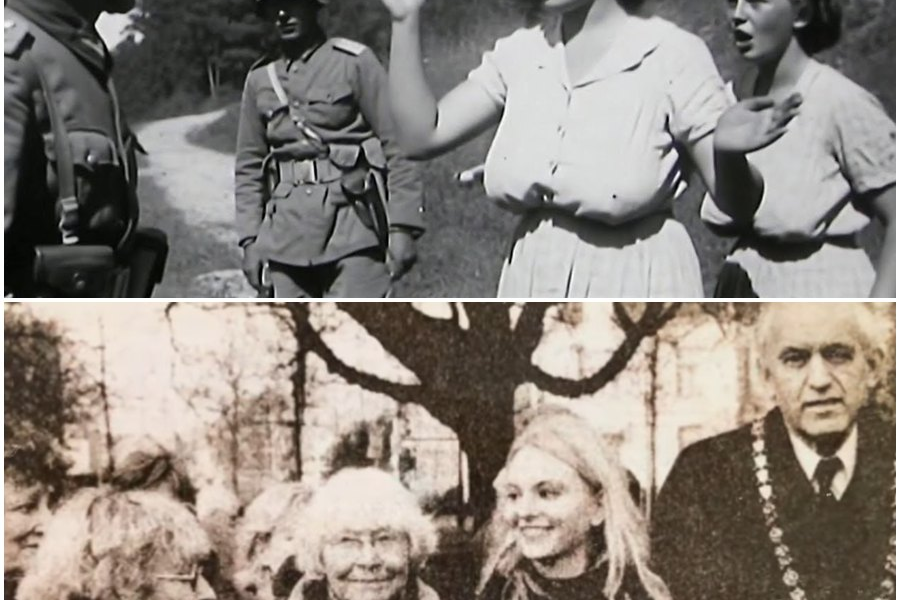
The sisters were instructed to approach selected targets in public spaces—train stations, cafes, village squares—engaging them in conversation, feigning interest, suggesting a quiet walk.
From there, the path often led into isolated woodland.
What happened in those forests would rarely be discussed, even decades later.
Because the truth was not cinematic.
It was abrupt.
It was irreversible.
And it left marks that no medal could erase.
The Weight of a Decision
To understand the magnitude of what these sisters undertook, one must grasp the climate of occupied Netherlands.
Jewish families were being rounded up and transported eastward.
Resistance members were executed publicly.
Collaboration networks operated openly.
The choice to act was not theoretical.
It was immediate.
According to later interviews, Truus would reflect that they never viewed their actions as heroic. They saw them as necessary.
“They were the enemy,” she once said in a recorded conversation decades later. “And the enemy was taking our people.”
But moral clarity in wartime does not erase emotional consequence.
Freddie, the younger sister, would later admit that after certain missions, she could not sleep.
The forest remained with her.
The Arrival of a Third Name
In time, the sisters joined forces with another young resistance fighter, Hannie Schaft, whose red hair and fierce determination would later make her one of the most recognizable figures in Dutch resistance lore.
Together, the trio became part of a sabotage group focused on eliminating high-risk collaborators and officers involved in oppressive measures.
They learned to ride bicycles with concealed weapons.
They memorized patrol patterns.
They rehearsed alibis.
The sisters’ youth remained their greatest disguise.
A Forest That Never Forgot
One particular mission, documented in postwar testimonies, involved luring a mid-level officer suspected of coordinating deportation logistics.
Freddie approached him first, striking up conversation near a canal bridge.
Truus waited ahead along a forest path.
The officer followed willingly.
He never returned to his post.
The sisters did.
But something in them did not.
War compresses morality into impossible equations.
At sixteen, most are deciding which books to read, which friends to trust.
Truus was deciding who would live and who would not.
Courage or Calculation?
Historians continue to debate how to categorize their actions.
Were they guerrilla fighters?
Assassins?
Freedom fighters?
Children manipulated by adults?
The answer depends on perspective.
Dutch national memory often frames them as symbols of defiance.
Yet the methods they employed—deception, seduction, lethal ambush—complicate comfortable narratives.
There is no romanticism in the aftermath of violence.
Only silence.
The Psychological Cost
After the war ended in 1945, celebrations erupted across the Netherlands. Flags reappeared. Occupation forces withdrew. Those who had resisted were praised.
But reintegration was not simple.
Freddie once described feeling disconnected from peers who had experienced the war differently.
They had carried weapons before they could legally drive.
They had navigated moral terrain few adults could endure.
For years, they rarely spoke publicly about specific missions.
The silence was protective.
And necessary.
A Story Historians Struggled to Tell
For decades after the war, the Oversteegen sisters’ story remained partially obscured.
Postwar Dutch society focused heavily on rebuilding and reconciling.
Stories that blurred lines between innocence and lethal resistance were harder to narrate.
It was not until later in life that Truus began granting interviews, emphasizing not the drama of their missions but the moral urgency that shaped them.
She resisted being portrayed as glamorous.
“There was nothing glamorous,” she said. “It was survival.”
Freddie remained even more reserved.
The forest, she suggested, was not a place she wished to revisit—physically or in memory.
The Netherlands Under Occupation
During the occupation, cities like Amsterdam and Haarlem became centers of both compliance and resistance.
Underground newspapers circulated secretly.
Sabotage operations targeted rail lines.
Networks hid thousands from deportation.
Within this broader context, the Oversteegen sisters were not anomalies—but they were rare.
Teenage girls acting as operational agents in lethal missions challenged assumptions about both gender and youth.
The Price of Growing Up Overnight
When asked years later how they reconciled their actions with their age, Truus responded with unsettling clarity:
“We were not children anymore.”
War had eliminated that option.
The sisters did not view themselves as victims of circumstance, though they acknowledged the toll.
They believed in the necessity of resistance.
Yet belief did not erase memory.
Recognition and Reflection
In later decades, Dutch authorities formally recognized their contributions.
Ceremonies were held.
Medals awarded.
But public acknowledgment could not simplify the past.
For some observers, their story is one of empowerment—a testament to agency in the face of tyranny.
For others, it is a reminder of how conflict forces youth into roles that should never exist.
Both truths coexist.
The Moral Labyrinth
The Oversteegen sisters’ legacy forces difficult questions:
At what age does moral responsibility begin?
Can innocence be weaponized without being destroyed?
Is survival justification enough?
Historians often struggle to narrate such stories without either sanitizing or sensationalizing them.
Because at its core, this is not a tale of adventure.
It is a story of lost adolescence.
After the Guns Fell Silent
When the war ended, Europe faced physical reconstruction.
The sisters faced something less visible.
They had lived in secrecy for years.
They had operated in moral gray zones.
They had seen death up close before adulthood.
Normal life felt distant.
Freddie later focused on art and family.
Truus became more publicly vocal about the resistance’s history, ensuring that the sacrifices—however complex—were not forgotten.
Why Their Story Endures
There are countless tales of resistance across Europe.
But the image of two teenage girls cycling through occupied streets, appearing harmless while carrying unimaginable responsibility, captures something uniquely unsettling.
It challenges stereotypes.
It disrupts easy hero narratives.
It reminds us that war reshapes identity without consent.
A Forest Still Standing
Today, the forests where some of these missions unfolded remain quiet.
Trees have grown taller.
Paths have shifted.
Visitors walk unaware of what transpired decades earlier.
History rarely announces itself with plaques in every place it occurred.
Sometimes it lingers invisibly.
The Unanswered Question
Were they heroes?
Most in the Netherlands would say yes.
Were they children forced into adult decisions?
Undeniably.
Their story refuses simplification.
It lives in tension between courage and trauma.
Between necessity and cost.
Between innocence and irrevocable action.
War often demands the impossible from adults.
From Truus and Freddie Oversteegen, it demanded something even more profound.
It demanded that they trade adolescence for resistance.
And in doing so, it created a legacy both courageous and deeply disturbing—one that continues to challenge how we define heroism, morality, and the true price of growing up too soon in history’s darkest hours.
Note: Some content was generated using AI tools (ChatGPT) and edited by the author for creativity and suitability for historical illustration purposes.