
In early January 1945, General Joseph Harpe stood before a map that spelled his doom in simple arithmetic. His Army Group A held a 500 km front along the Vista River, stretching from the Carpathian Mountains in the south to the Naru River in the north. He commanded 450,000 men and approximately 1,100 tanks. On paper, a substantial force.
In reality, a death sentence. The math was brutal. 450,000 men across 500 km translated to just 900 soldiers per kilometer of front. Soviet doctrine considered 2,500 men per kilometer the absolute minimum for effective defense. If you’re interested in how wars are actually decided by logistics, math, and doctrine, subscribe now, turn on notifications, and stay tuned for more in-depth World War II analysis.
Let’s continue. HARP was defending with barely a third of what military science demanded. Every staff officer in the room understood what those numbers meant. The Vermacht had compounded the problem through dispersion. Rather than concentrating armored reserves for counterattacks, German high command had distributed tanks across the entire front in small packets.
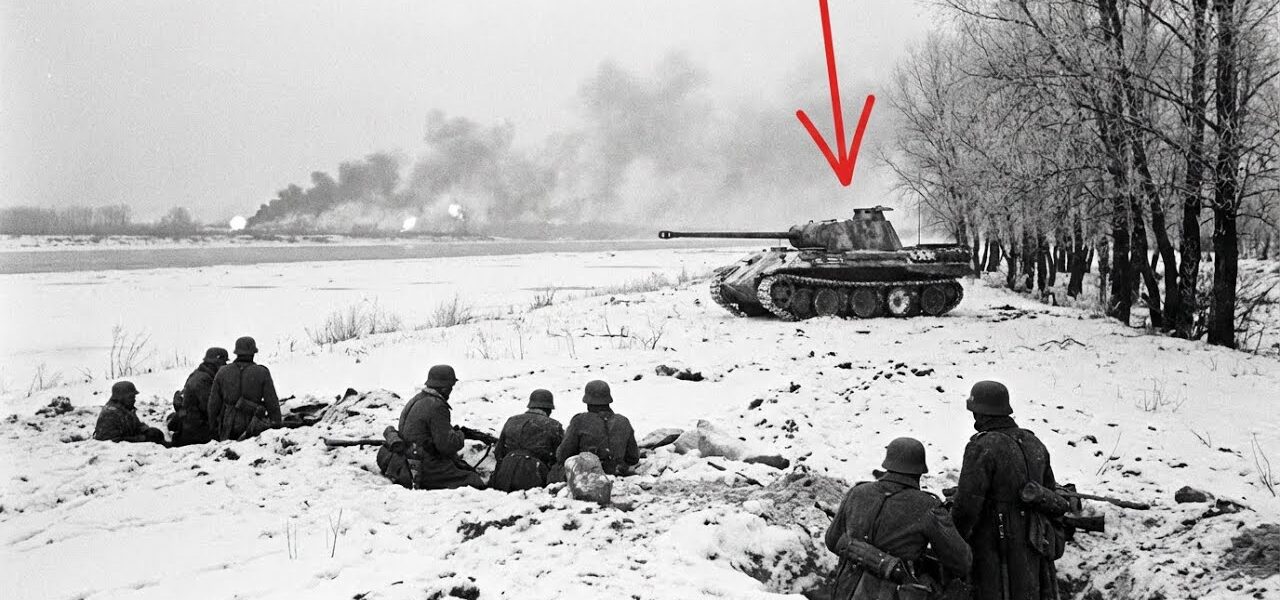
A company here, a battalion there. The Mark 5 Panthers, the backbone of German armored defense with their deadly 75mm KWK 42 L70 guns, sat scattered in static positions. These machines could destroy Soviet tanks at ranges exceeding 1,500 m. But dispersed as they were, they could not mass for the decisive counterstrokes that German doctrine demanded.
Fuel shortages strangled what remained of German mobility. The operational radius of the 24th Panzer Corps HARP’s primary mobile reserve had shrunk to fewer than 200 km. Panthers required 270 L of gasoline per 100 km of road movement. More across country, the fuel simply did not exist. The strategic reserve that might have plugged a breakthrough had been bled dry by the Ardan’s offensive in the west and the defense of Budapest in Hungary.
Harp’s request for reinforcements met with refusal. Instead of tanks, he received Hetszer tank destroyers. Lowprofile turretless vehicles effective for ambush tactics but worthless for mobile counteroffensives. The commanders surveying their positions on the morning of January 11th knew the truth.
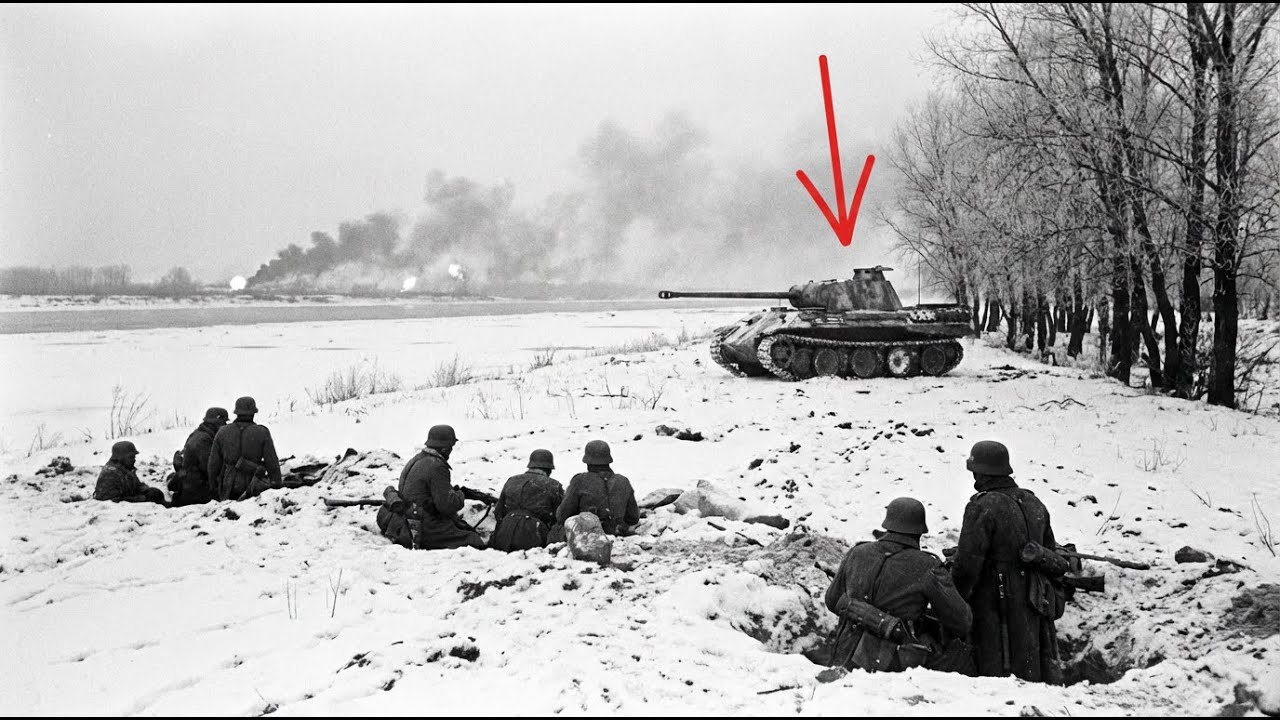
They were holding a line they could not defend, waiting for an attack they could not stop. Across the frozen Vistula, concealed within three massive bridge heads on the western bank, an unprecedented concentration of mechanized force had taken shape during the first week of January. At the Magnazoo bridge head alone, the First and Second Guard’s tank armies had masked over 1500 armored vehicles.
T3485 medium tanks and the massive 70 ton JS2 heavy tanks sat in assembly areas deliberately positioned beyond German artillery range 40 km deep into Polish territory. The physical arrangement embodied Soviet deep battle doctrine translated into steel and earth. Forward assault infantry divisions occupied the first positions, their supporting artillery positioned wheelto-heel along concealed firing lines.
Hundreds of 76 mm divisional guns and 122mm howitzers waited for the signal. Behind them massed the breakthrough echelons. Rifle cores reinforced with self-propelled artillery and engineer battalions tasked with clearing lanes through German obstacles. Only after these forces ruptured the tactical defenses would the tank armies surge forward.
Their mission was not to fight the battle, but to exploit its results. to drive deep into the operational rear before German reserves could establish successive defensive lines. Supply columns had stacked ammunition and fuel drums in forward depot. Each tank army had been allocated sufficient reserves for 300 km of advance without resupply from rear bases.
At dawn on the 12th of January 1945, the frozen silence along the Sandir’s bridge head shattered. Artillery pieces arrayed wheelto-wheel erupted in synchronized fire, their muzzle flashes illuminating the pre-dawn darkness. Shells arked across the narrow gap between Soviet and German lines, impacting defensive positions with methodical precision.
The ground convulsed, frozen earth fountain skyward. Within minutes, the static defensive line began to disintegrate under the weight of Marshall Kv’s bombardment. The first Ukrainian front attacked across a 40 km breakthrough sector. A deliberately concentrated assault designed to overwhelm rather than probe. Soviet doctrine had evolved since the desperate battles of 1941.
Mass artillery preparation gave way to infantry assault waves, clearing obstacles and suppressing surviving strong points. German defenders faced this onslaught with formations already depleted by years of attrition. Mark 5 Panthers remained potent weapons in experienced hands. The Panthers superior penetration and 80 mm frontal armor granted advantages in direct engagement.
Hetszer tank destroyers lurked in prepared positions between tree lines and farm buildings. Their 75mm guns made effective ambush weapons, but numbers told the strategic story. The Soviet offensive arrived with weight and concentration that German defenders could not match. JS2 heavy tanks appeared in the breakthrough sector.
Their presence alone forced German armor to reconsider engagement ranges. Surviving Panthers withdrew rather than risk close combat against 122 mm guns capable of penetrating any armor the Vermach fielded. By midday, the 40 km sector showed signs of collapse. Soviet mobile forces pushed beyond the tactical defenses, entering the intermediate zone where German reserves should have been concentrating for counterattack.
Those reserves weakened by transfers west and attrition failed to materialize in sufficient strength. The breach widened. Armored columns began forming march order. Dawn broke on 13th January along the Vistella’s western bank. At the Magnesu and Pulawi bridge heads, Zhukov’s first Bellarussian front had packed 24 rifle divisions and 5,000 artillery pieces into attack sectors barely 8 km wide.
The density exceeded 250 guns per km, a concentration that dwarfed even the preparations at Kursk. The barrage opened at 0830 hours. For 25 minutes, the ground itself seemed to liquefy under the impact of high explosive and Katusha rockets. German forward positions, already weakened by months of attrition warfare, disintegrated.
The 9inth Army’s defensive crust, thinned to hold a front stretching over 400 km, could not absorb this focused violence. By noon, Soviet infantry had penetrated 15 km into the German defensive system. The pace accelerated. Unlike Konv’s operation to the south, Zhukov employed a different calculus.
The rifle formations would create the operational corridor. The armored fist would strike only when the tactical zone was fully ruptured. By day end, forward elements reported positions 100 km beyond their jumpoff points. The advance consumed terrain at a rate that collapsed German plans for elastic defense. Army Group A’s reserves, already committed to containing KV’s penetration, could not reach Zhukov’s sector in time.
General von Melanthan observing the offensive’s opening phase described it with professional clarity. The Russian offensive was delivered with a weight and fury never yet seen in war. It was clear that their high command had completely mastered the technique of maintaining the advance of huge mechanized armies.
On January 14th, the 11th tank corps received its movement orders along designated assembly areas behind the Pulawi bridge head. Diesel engines roared to life in synchronized succession. Tank commanders standing in open hatches relayed hand signals down columns extending into the pre-dawn darkness. T3485s and IS-2 heavy tanks maneuvered onto hardened roads forming march formations that stretched 20 to 25 km.
Once fully deployed, the corridor punched through German tactical defenses now served as the exploitation route. March discipline proved critical. Each tank maintained 50 m intervals to prevent compaction under air attack. Self-propelled artillery regiments integrated directly into the columns.
Fuel trucks and ammunition carriers interspersed with combat vehicles, ensuring the advancing formation maintained operational tempo. German forces attempted to establish defensive positions along the exploitation route. Panther tanks positioned hold down along ridge lines. The asymmetry favored German armor in individual engagements.
Panthers could penetrate T34 frontal armor at ranges exceeding 1,500 m. Soviet commanders countered this technical disadvantage through operational velocity. Rather than accepting setpiece battles, tank columns bypassed resistance, leaving isolated German positions for follow-on rifle divisions to reduce. The IS-2 heavy tanks proved decisive when direct engagement became unavoidable.
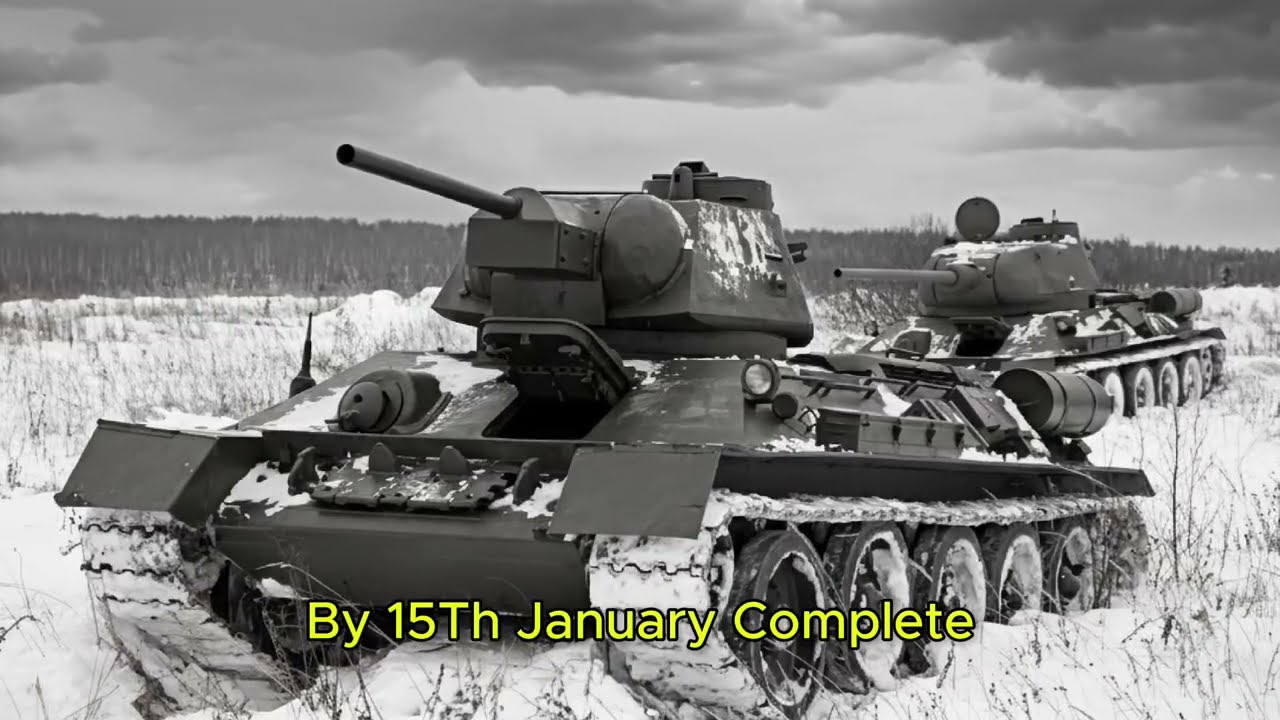
Their 122mm guns forced Panthers to withdraw or risk destruction at medium ranges. But the 11th tank corps advanced not to destroy German armor. Its mission was to penetrate deep into the operational rear, severing communication lines and collapsing defensive cohesion entirely. By 15th January, complete Soviet tank armies accelerated from assembly areas into terrain where German defensive coherence had disintegrated.
Steel rivers of T34s, JS2, heavy tanks, and tracked support vehicles stretched across the Polish countryside in March formations extending 25 km. The terrain itself facilitated this mechanized warfare. Open Polish plains frozen solid by January temperatures provided firm ground for tracked vehicles.
On January 17th, Warsaw fell. The 47th Army completed its encirclement while steel columns hundreds of kilome to the west maintained their relentless advance. Warsaw’s liberation carried immense symbolic weight. Poland’s capital freed after occupation that began in September 1939. But the operational center of gravity had already shifted beyond the Vistila.
The city represented a political milestone, not a military objective requiring the commitment of mobile formations needed for deep penetration operations. The next day, the Second Guard’s tank army executed an 80 km penetration in 24 hours. The advance began at dawn and continued through the night, exploiting the T3485’s critical advantage, the ability to maintain combat effectiveness across terrain and darkness that halted German counter movement.
The T3485 possessed wide tracks distributing weight across frozen ground and snow covered fields, allowing sustained speed where German armor bogged down. Soviet tank brigades operated in mass formations, accepting mechanical breakdowns as inevitable. A brigade might lose 30% of its vehicles to mechanical failure during an 80 km dash.
The remaining 70% still constituted overwhelming force at the breakthrough point. Night operations magnified these advantages. German doctrine relied on visual coordination between tanks, infantry, and anti-tank guns, requiring daylight for effective deployment. The second guards tank army moved through darkness with forward detachments navigating by compass bearing, bypassing strong points rather than reducing them.
Rear area logistics units, supply depots, and communication nodes found themselves overrun before warning reached forward defenses. German commanders woke to discover Soviet armor 40 km behind their prepared positions. By evening, rifle forces remained 40 to 60 km behind the armored spearhead. The second guard’s tank army operated in enemy rear areas without infantry support, supplied by captured German fuel dumps.
This calculated risk accepted temporary vulnerability in exchange for speed, denying German forces time to establish defensive lines. On January 19th, a border marker stood in snow-covered farmland east of Hoen Salsa. At 14:30 hours, the lead elements of an armored spearhead rolled past it without ceremony.
Tank commanders barely registered the significance. They had driven 80 km in 18 hours. The geographic boundary meant less to them than the next fuel dump. Soviet forces had crossed into the German Reich. The next day brought a dramatic shift. Marshall Kov issued categorical orders. Third guards tank army would execute an immediate 90deree turn from its westward axis toward Berlin.
The new objective lays south the industrial basin of Upper Celisia. Soviet intelligence reported German demolition teams preparing systematic destruction of coal mines and factories producing 25% of German coal output. Stalin himself demanded these assets be captured intact. The maneuver violated basic principles of armored warfare.
Tracked columns excel at exploitation along prepared axes, not perpendicular reorientation under combat conditions. But the pivot began. The westward momentum toward Berlin evaporated in service of industrial pragmatism. By 22nd January, the crisis of overextension became quantifiable. Tank army forward elements had reached Schneider.
The nearest rifle formations occupied positions 40 to 80 km to the rear. The tracked columns had consumed space faster than the infantry logistics system could contract it. Rifle divisions advanced at 25 km per day when roads permitted. Soviet armor sustained 40 to 50. Each day added 15 to 25 km to the separation distance. On 23rd of January, the forward detachments of the fourth tank army crested the final rise.
Below them stretched the Odor River, ice choked, 150 m wide, 64 km from Berlin. After a 14-day offensive spanning 350 km, Soviet armor made visual contact with the objective. By nightfall, forward elements secured bridge heads at Onlauo and Brig. The speed of the Soviet advance had outpaced German defensive preparations by 5 days.
But the strategic calculation crystallized a dangerous truth. Four bridge heads secured. Berlin within operational striking distance and the extended salient created catastrophic vulnerability. Between 26th and 28th January, reconnaissance reports revealed a threat that forced Jukov to recalculate his entire operational geometry.
German units from the collapsing Corland pocket and east Prussia began concentrating along the Pomeranian corridor aimed directly at the exposed northern shoulder of the Soviet salient. The advance that delivered four river crossings had created a corridor 350 km deep but dangerously narrow. The German roving pocket under Generals Naring and Sen moved westward through terrain that should have been impassible.
The column stretched across 15 km. Panthers and Panzer force interspersed with halftracks and civilian refugees. They crossed the boundary between Zukov’s first Bellarussian front and KV’s first Ukrainian front during darkness, moving through sectors theoretically controlled by Soviet forces, but actually occupied only by intermittent patrols.
On January 30th, Zhukov committed First Polish Army and Third Shock Army to stabilize the northern sector. These formations, originally designated for the Berlin assault, redeployed northward to block the German breakout. The decision sacrificed operational momentum for security. On 31st January, the second guard’s tank army punched across the frozen odor at Kestran, establishing a bridge head 65 km from Berlin.
Soviet engineers constructed pontoon crossings under fire. The bridge head measured roughly 12 km wide and 8 deep. insufficient for a direct assault, but critical for future operations. On February 2nd, the Stavka declared the Vistella Odor operation complete. Forward elements had covered over 480 km in 3 weeks.
Ammunition stocks dropped to 3 days of combat consumption. Fuel shortages idled tank brigades that had outrun their logistics trains by 150 km. The price stood recorded in stark arithmetic. Soviet forces suffered 194,191 casualties. 43,476 killed in action, 150,715 wounded. Each kilometer cost approximately 388 Soviet soldiers. The German accounting told a more catastrophic story.
Army Group A ceased to exist as a coherent formation. Of nine Panzer divisions assigned in early January, seven were effectively destroyed. The 16th Panzer Division reported 24 operational tanks from an authorized strength of 160. The 17th Panzer Division mustered 11 infantry divisions fragmented into battalion-sized K group scattered across Cisia.
The 68th Infantry Division entered Soviet captivity nearly intact. 12,000 men surrounded at Pausnan. Material losses compounded the personnel devastation. Army Group A abandoned 1,377 artillery pieces during the withdrawal. 354 of them, 88 mm guns that represented the backbone of anti-tank defense. The Soviets cataloged 583 destroyed or captured Panzers, 147 aircraft destroyed, most on the ground at overrun forward airfields.
6 months of accumulated fuel stocks, approximately 18,000 tons, fell to the advancing fronts when depot commanders failed to execute demolitions before evacuation. When German cgraphers updated the order of battle maps in March, Army Group A’s designation disappeared entirely. The formations were reconstituted as Army Group Center through administrative reshuffleling, a paper reorganization that could not restore combat power.
General Vidling’s assessment proved prophetic. The Eastern Front is like a house of cards. If there is a breakthrough at one single place, the whole thing will collapse. The 60-day pause between February and April was not hesitation, but necessity. The Soviet operational method demanded functional logistics.
By midappril, first Bellarussian front had accumulated 7,147 rail cars of ammunition at forward depots. At 3:00 a.m. on 16th April, 20,000 guns opened fire on the CEO Heights. The barrage announced the Berlin operation, not a new campaign, but the terminal phase of the offensive begun in January. The geographic corridor carved by the winter advance now funneled three Soviet fronts toward a single objective.
The mechanics unfolded with industrial precision. Forward observation posts disintegrated under the bombardment. Communication wire bundles vaporized. Battalion headquarters ceased to exist as functional entities. The barrage created not simply casualties but organizational paralysis, severing the neural pathways that allowed Vermach forces to conduct coordinated defense.
When rifle divisions advanced against the CEO heights, tank armies waited in reserve for the rupture to widen. The first and second guard’s tank armies committed on April 17th, their operational depth reaching 90 km within 5 days. a velocity that rendered traditional defensive planning obsolete. By 21st April, artillery placed shells in central Berlin.
By 25th April, encirclement closed as first Bellarussian and first Ukrainian fronts linked at Keton. On 30 April, the victory banner rose over the Reichdto. On 2nd May, Vidling signed surrender documents. 134,000 prisoners laid down arms. On May 8th at Carl’sh, German commanders affixed signatures to unconditional surrender.
Field marshal Wilhelm Kaidle, Admiral Hans Gayorg Fonfriedberg and General Hans Jurgen Stumpf represented the three branches of the Vermacht that had failed to hold the Vistula. The line of causation ran directly from the Vistella river crossings in January to this Berlin suburb in May. a single operational continuum spanning four months, 600 km, and the destruction of German military capacity east of the Elba.
The Vermacht, stretched to breaking across that 500 km front in early January, had finally collapsed, not from a single blow, but from the relentless arithmetic of forces they could never sustain. If you want more clear, well-ressearched history and analysis like this, subscribe to the channel. Thanks for watching.