Outgunned and invisible, a small wooden boat snuck into the fleet, and one shot changed naval history forever. nu

Outgunned and invisible, a small wooden boat snuck into the fleet, and one shot changed naval history forever
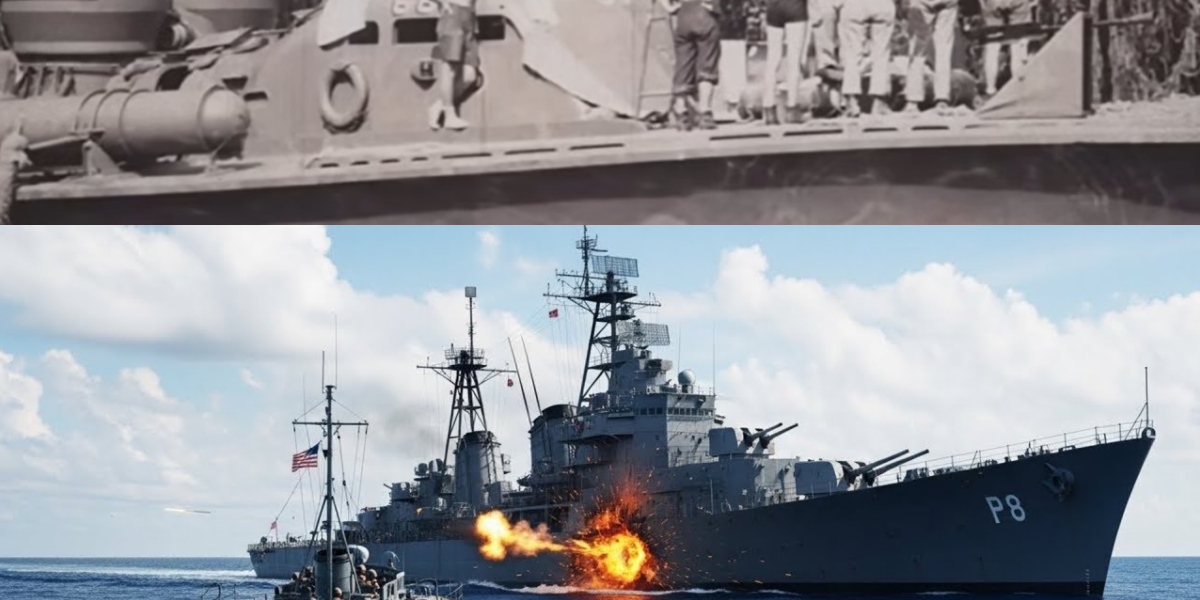
At 10:47 p.m. on December 11, 1942, Lieutenant Lester Gamble throttled his PT-37 through the ink-black waters off Guadalcanal. Through his binoculars, he watched eleven Japanese destroyers—the “Tokyo Express”—moving south like silent predators.
Gamble was 28 years old. His “ship” was 77 feet of plywood and mahogany, weighing just 40 tons. His target was the Teruzuki, a 440-foot Akizuki-class destroyer, a steel fortress carrying eight rapid-fire guns and the most advanced fire-control radar in the Japanese fleet. The math was simple: it was David vs. Goliath, except Goliath had armor plating and 350 men. In the Solomon Islands, American sailors had a different word for attacking destroyers in wooden boats: Suicide.

PART I: MOSQUITOES IN THE DARK
The Japanese called PT boats “Mosquitoes.” They were annoying, small, and easy to swat. But tonight, the Tokyo Express was delivering the one thing the Japanese troops in the jungle needed most: hope. Admiral Riso Tanaka, the “Master of Night Operations,” was dropping hundreds of watertight drums filled with rice and ammunition into the currents.
Gamble’s boat, PT-37, was accompanied by PT-40 and PT-48. Three wooden boats against a fleet that had crushed steel American warships. Gamble throttled back to idle, letting his boat drift. Tanaka’s lookouts were scanning for phosphorescent wakes—the telltale white “rooster tail” of a PT boat at high speed. Gamble gave them nothing to see.
“Range 1,200 yards… 1,100 yards,” the torpedo man whispered. The destroyer’s silhouette grew until Gamble could see the bridge superstructure. PT boats had no radar or sonar; everything was done by eye, a stopwatch, and a prayer.
PART II: THE REINS OF THE MARK 8
Gamble had four Mark 8 torpedoes. Each carried 600 pounds of Torpex explosive, enough to break a destroyer’s keel. The problem? The Mark 8 had a 60% failure rate in combat. They ran too deep, they dived into the mud, or they simply failed to explode on contact.
At 1,000 yards—well within the range where a single searchlight would turn PT-37 into a burning coffin—Gamble lined up his bow. You didn’t aim the torpedoes on a PT boat; you aimed the entire boat.
“Fire one! Fire two!”
Twin blasts of compressed air followed. The boat lurched as 6,000 pounds of metal left the tubes. Gamble didn’t wait to see the result. He spun the wheel hard to starboard and slammed the throttles to maximum. The three Packard engines screamed, pushing the boat to 41 knots as they leaped onto a plane and raced for the darkness of the coast.
PART III: THE LAKE OF FIRE
Sixty seconds passed. Then fifty. Then forty.
A massive detonation tore through the night. A column of water shot 200 feet into the air behind Teruzuki’s main mast. The explosion was so bright that Gamble could see individual Japanese sailors on the deck. The torpedo had struck the portside aft, shattering the engine room and rupturing the fuel tanks.
Burning oil spread across the water, turning the Solomon Sea into a lake of fire. Tanaka, the Admiral, was thrown across the bridge and knocked unconscious. His flagship was dead in the water.
While Tanaka was being evacuated to another ship, a second wave of PT boats arrived to exploit the chaos. PT-44 and PT-110 charged in, forcing the remaining destroyers to abandon their rescue efforts to defend themselves. For ten crucial minutes, the fires on the Teruzuki burned unchecked.
PART IV: THE DEPTH CHARGE RECKONING
By midnight, the Teruzuki was a floating bomb. The fires had reached the aft magazines, and the small-arms ammunition was cooking off like popcorn. But the real danger lay further back: 72 Type 95 depth charges, each packed with 300 pounds of explosive.
Captain Orita ordered the ship scuttled. Sailors leaped into the water, some rowing for the shore of Guadalcanal just three miles away. At 4:40 a.m., the fire finally reached the depth charges.
The resulting explosion was so massive it was seen from Henderson Field, twenty miles away. A giant orange fireball turned night into day. The shockwave was so powerful it knocked men off their feet on ships a mile away. When the smoke cleared, the Teruzuki was gone.
PART V: THE STRATEGIC FALLOUT
The loss was catastrophic for Japan. The Teruzuki was one of only two such advanced destroyers in existence. But the blow to Tanaka’s reputation was even worse. Losing a $3 million flagship to an $85,000 “mosquito” made of plywood was unacceptable to Tokyo. Tanaka was reassigned to land duty in Burma, ending the career of Japan’s best night-combat admiral.
For the Americans, the victory changed everything. It proved that PT boats weren’t just for harassment; they were giant-killers.
The Survival of PT-37: Gamble and his crew returned to Tulagi as heroes, but their boat’s luck eventually ran out. Seven weeks later, PT-37 was intercepted by a Japanese destroyer during a dawn patrol. This time, the steel ship won. A 5-inch shell disintegrated the plywood hull in seconds. Gamble and his crew survived the sinking, but the “Giant-Killer” was claimed by the same waters that held its victim.
EPILOGUE: THE WRECK AT 2,600 FEET
For 83 years, the Teruzuki lay forgotten. On July 10, 2025, an ocean exploration team finally located her at a depth of 2,600 feet in Ironbottom Sound. The bow section lay separate from the stern, twisted by the massive depth charge explosion. The gun turrets still pointed toward the surface, silent sentinels of a night when plywood defeated steel.
Lester Gamble died in 1993. He never called himself a hero. In his view, he was just a man who aimed his boat at a shadow and hoped the torpedo ran straight. But that single hit shortened the war on Guadalcanal, proving that in naval warfare, audacity is the greatest equalizer.
Note: Some content was generated using AI tools (ChatGPT) and edited by the author for creativity and suitability for historical illustration purposes.