No Torpedoes, Just Skin: When these two ships collided, the war became a brutal deck-level brawl. nu

No Torpedoes, Just Skin: When these two ships collided, the war became a brutal deck-level brawl
At 01:53 on November 1, 1943, Lieutenant Charles Hutchins stood on the bridge of the USS Borie, tracking a radar blip 8,000 yards north of the Azores. Hutchins was 30 years old, a former salesman from Indiana who had returned to the Navy after Pearl Harbor. He was commanding a “tin can”—a Clemson-class destroyer built in 1920, ancient by the standards of WWII.
His target was U-405, a deadly German Type VIIC submarine commanded by the veteran Korvettenkapitän Rolf-Heinrich Hopman. The North Atlantic was screaming with 40-knot winds and 15-foot seas. What began as a standard patrol was about to become the most bizarre and violent ship-to-ship encounter in modern naval history.

PART I: THE UNEXPECTED EMBRACE
After a chaotic depth-charge run that malfunctioned and accidentally blew the U-boat to the surface, the two vessels engaged in a frantic gun duel. U-405 was agile, turning in tight circles that frustrated the Borie’s attempts to bring her main batteries to bear. Hutchins, fearing a stern torpedo shot from the German, made a desperate call: “Prepare to ram!”
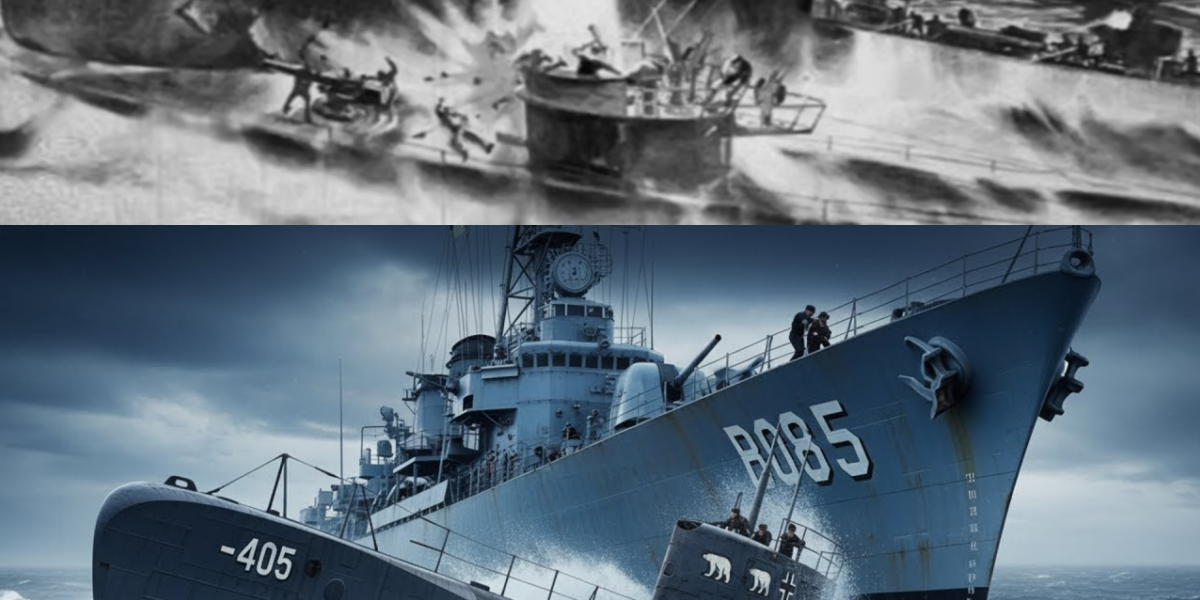
The Borie surged to 25 knots. Hutchins aimed for the submarine’s starboard quarter. But as the destroyer closed the final yards, a massive Atlantic swell lifted the Borie’s bow high into the air. Instead of slicing through the U-boat’s hull, the destroyer’s bow crashed down directly onto the U-405’s forward deck.
The 1,200-ton destroyer was now perched on top of the submarine like a grotesque see-saw. Locked together in a grinding, metal-shrieking embrace, the two ships rolled in 20-foot swells.
PART II: 10 MINUTES OF PRIMITIVE WAR
Hutchins looked down from his bridge, just 30 feet above the German conning tower. He could read the numerals on the sub; he could see the polar bear insignia. Suddenly, the German hatches flew open.
“They’re coming out!” someone screamed on the Borie’s deck.
The Germans were racing for their 20mm anti-aircraft guns. If they manned those cannons, they could shred the Borie’s exposed crew in seconds. But the Borie’s main 4-inch guns were useless—they couldn’t depress low enough to hit a target literally beneath their own bow.
The battle shifted from 20th-century technology to 10th-century savagery. Lacking gun authority, the American sailors reached for anything that could kill:
-
Small Arms: Thompson submachine guns and semi-auto rifles barked from the Borie’s rails, picking off Germans as they emerged from the hatch.
-
Improvised Missiles: Chief Boatswain’s Mate Walter Kuras, finding his gun useless, grabbed an empty 4-inch brass shell casing—weighing several pounds—and hurled it like a club, knocking a German sailor overboard.
-
Knives: Fireman David Southwick, out of ammo, drew his sheath knife and threw it, striking a German in the chest.
-
Signal Flares: One German took a Very pistol flare directly to the torso; the white phosphorus burned through his foul-weather gear instantly.
For ten minutes, the two crews fought face-to-face in a flickering landscape of searchlights and sea spray.
PART III: THE SECOND COLLISION
The sea finally wrenched the ships apart. U-405, heavily damaged but still floating, tried to limp away into the darkness. Hutchins extinguished his searchlights, tracking the sub on radar like a predator.
When Hopman tried to turn and ram the Borie in a final suicide move, Hutchins outmaneuvered him. He pivoted the Borie’s stern and fired a salvo of depth charges set to “shallow.” They detonated six feet from the U-boat’s hull.
The U-405 stopped dead. White flares—the international signal for surrender—shot up from the submarine. Hutchins ordered a ceasefire. He watched as Germans scrambled into yellow rubber life rafts. But the ocean wasn’t finished.
Suddenly, the Borie’s sonar operator reported a torpedo wake from a second U-boat in the area. Hutchins had no choice. To save his ship, he had to maneuver immediately. The Borie surged forward, and in the chaos, the destroyer’s bow accidentally plowed through the German life rafts. None of the 49 Germans from U-405 survived the night.
PART IV: THE DEATH OF THE BORIE
The victory was absolute, but the cost was devastating. The Borie’s hull had been pulverized during the ramming. The forward engine room was a lake of saltwater; the seams were splitting.
As dawn broke on November 2nd, the “tin can” was sinking. The 40-foot swells made towing impossible. Hutchins gave the order: Abandon Ship.
The evacuation was a nightmare. In the 44°F water, hypothermia set in within minutes. USS Barry and USS Goff circled, but they couldn’t come alongside in the mountainous seas. Men jumped into the freezing void.
-
Morrison Brown: The Borie’s Engineer, stayed to ensure every man got off. He jumped last, swam twenty yards, and vanished into a trough. He was never found.
-
The Toll: Of the 143 Americans who survived the battle, 27 drowned in the rescue attempt.
Finally, to prevent the Borie from becoming a hazard or falling into enemy hands, the USS Barry was ordered to sink her. It took 40 shells to finally put the stubborn old destroyer down.
EPILOGUE: THE GHOSTS OF THE NORTH ATLANTIC
The USS Borie and U-405 now lie on the floor of the Atlantic, 49° North, 31° West, three miles deep. They remain forever linked by 64 minutes of the most intense combat of the war.
Lieutenant Charles Hutchins was awarded the Navy Cross. The battle became a legend, studied at Annapolis as the premier example of “Crisis Resource Management” and improvised combat. It proved that while steel and radar win the war, it is the grit of the sailor—the man willing to throw a shell casing when the gun fails—that defines history.
Note: Some content was generated using AI tools (ChatGPT) and edited by the author for creativity and suitability for historical illustration purposes.