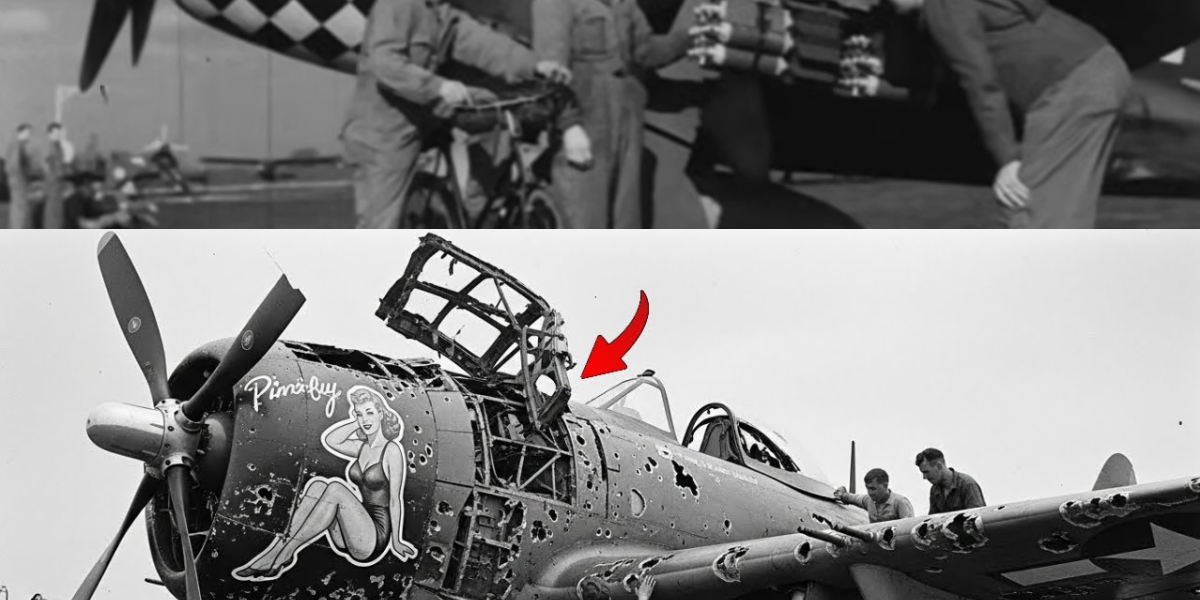

One P-47 vs. 48 Japanese fighters – The record that redefined aerial combat
On the morning of October 11, 1943, the sky over Wewak, New Guinea, was a blinding, tropical blue. At 28,000 feet, Lieutenant Colonel Neel Kearby looked down from the cockpit of his Republic P-47 Thunderbolt, “Fiery Ginger.” Beneath him lay the most heavily defended Japanese airbase in the Southwest Pacific.
Kearby was 32 years old, a tactician who believed in mathematics as much as muscle. For months, he had been told that the P-47—affectionately called the “Jug” because of its milk-bottle shape—was the wrong plane for the Pacific. It was too heavy. It couldn’t turn with the feather-light Japanese Zeros.

But Kearby had a theory. The Jug weighed eight tons, nearly double the weight of its adversaries. In a horizontal turning fight, he would die. But in a vertical dive, he was a falling anvil.
THE 9-TO-1 GAMBLE
Kearby was leading a tiny formation of just four Thunderbolts on a high-altitude reconnaissance sweep. As they crossed the coast, the radio crackled. A massive Japanese formation was approaching from the east: 12 twin-engine bombers escorted by 36 fighters. Forty-eight enemy aircraft against four.
Standard military doctrine dictated an immediate retreat. Any experienced pilot would have signaled his flight to turn for home. Kearby did the opposite. He signaled his three wingmen to drop their external fuel tanks.
“We’re going in,” he commanded.
Kearby knew his advantage was the 11,000 feet of empty air between him and the enemy. He rolled “Fiery Ginger” into a 70-degree dive.
THE SIX-MINUTE RECKONING
The P-47 accelerated like a stone dropped from a skyscraper. 300 knots became 350, then 400. The airspeed indicator needle vibrated violently as the seven-ton fighter hit terminal velocity.
The Japanese pilots never looked up. They were focused on the jungle below, never imagining that four “flying bathtubs” would initiate a suicidal charge from the stratosphere.
Kearby closed to 300 yards. His eight .50-caliber machine guns—the heaviest armament of any fighter in the theater—converged on a single point.
-
The First Kill: Kearby raked a Kawasaki “Tony” fighter. The Japanese plane didn’t just catch fire; it disintegrated under the weight of 200 rounds of lead delivered in three seconds.
-
The Second Kill: As he roared through the formation, he snapped his sights onto a Nakajima “Oscar.” A three-second burst turned the fighter into a flaming funeral pyre.
-
The Third Kill: Kearby zoomed back to altitude using the momentum of his dive. He spotted another fighter on the flank and dove again. The Oscar exploded mid-air.
In the chaos, Kearby’s wingman, Captain Dunham, radioed for help. Two Tonys were pinned to his tail, closing for the kill. Kearby rolled inverted and dove again. He was moving so fast—nearly 500 mph—that the Japanese pilots couldn’t even track him. He shredded both Tonys in a single pass, saving Dunham and bringing his total to five confirmed kills in under five minutes.
As he pulled out of his final dive, he caught a glimpse of another Oscar attempting to flee. He cut inside the turn, ignored the staggering G-forces that threatened to black him out, and hammered the Japanese fighter until its tail section fell off.
Six confirmed kills. One mission. A new American record.
FROM EXPERIMENT TO DOCTRINE
When Kearby landed at Port Moresby 90 minutes later, his mechanics found his aircraft almost untouched. He had dismantled an entire squadron by refusing to fight their way.
General George Kenney, commander of the Fifth Air Force, immediately drafted a recommendation for the Congressional Medal of Honor. Kearby had proven that the P-47 wasn’t a liability; it was a predator. His “Dive and Zoom” tactics became the gold standard for every Thunderbolt pilot in the Pacific.
THE PRICE OF THE ACE
Kearby was promoted to full Colonel and moved to a staff position at headquarters. He was too valuable to lose. But the rivalry between the Pacific’s top aces was intensifying. Richard Bong and Tommy McGuire were racking up kills in their P-38s, and Kearby couldn’t stand being grounded.
He requested permission to continue “occasional” combat flights. For three months, he balanced paperwork with dogfights.
On March 5, 1944, Kearby joined a routine sweep over Wewak. He spotted a damaged Japanese bomber and made a fatal mistake: he violated his own primary rule. “Never make a second pass at low altitude.”
Desperate to confirm the kill and increase his score, Kearby turned back at low speed. Five Japanese Oscars were waiting in the sun. They dove on the vulnerable “Fiery Ginger,” severing its control cables and rupturing the hydraulic lines.
Kearby managed to bail out at 1,500 feet, but he was too low. His parachute only partially deployed before he disappeared into the dense New Guinea jungle.
EPILOGUE: THE FINDING OF A HERO
For three years, Neel Kearby was listed as Missing in Action. It wasn’t until July 1947 that an Australian War Graves team hacked through the jungle near Dagua. They found the wreckage of “Fiery Ginger 4,” its nose buried deep in the earth.
Colonel Kearby was found nearby, still tangled in the trees where his parachute had caught. He had died alone, within sight of the very airfield where he had set his unbeatable record five years earlier.
Today, Kearby is buried with full military honors in Dallas, Texas. His legacy lives on in every tactical manual used by modern fighter pilots. He proved that in the air, brilliance isn’t about having the lightest plane—it’s about having the heaviest heart and the smartest strategy.
Note: Some content was generated using AI tools (ChatGPT) and edited by the author for creativity and suitability for historical illustration purposes.