
He Was Only 17 — and Hitler Had Him Executed
Chapter I – A Quiet Cell in Berlin (1942)
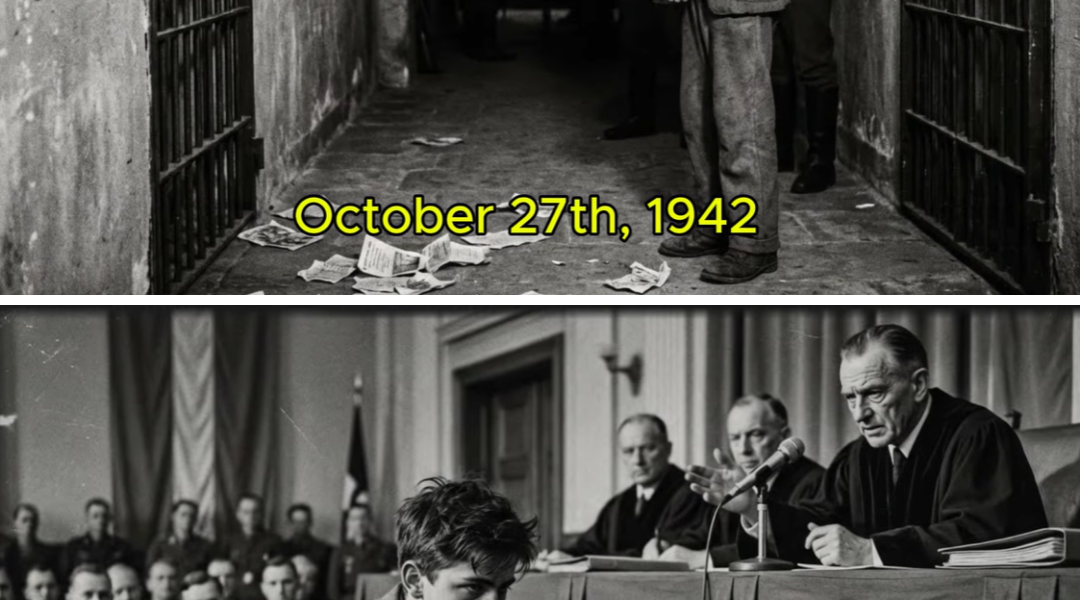
On the morning of October 27, 1942, the corridors of Plötzensee Prison in Berlin were unnaturally silent. The war was raging across continents. Cities burned. Armies clashed. Yet inside this gray stone prison, history paused for one small, terrible moment.
A 17-year-old boy was led down a narrow hallway.

He was not a soldier.
He carried no weapon.
He wore no uniform.
His name was Helmut Hübener.
Only hours earlier, he had been an apprentice clerk, a student, a teenager who enjoyed music, books, and long conversations with friends about the future. Now, the Nazi state had decided that he was too dangerous to live.
His crime was simple, and in Hitler’s Germany, unforgivable:
He listened to the truth—and shared it.
The guillotine waited.
Outside the prison walls, the German people were told the war was going well. Victory was inevitable. The Führer was infallible. But Helmut knew otherwise. And for knowing, he would die.
Chapter II – Growing Up Under a Lie
Helmut Hübener was born in Hamburg on January 8, 1925, into a working-class neighborhood shaped by hardship and honesty. His childhood, at first, was ordinary. He attended school, played with friends, and dreamed the quiet dreams of youth.
Then, in 1933, Adolf Hitler came to power.
Germany changed almost overnight. Flags appeared on buildings. Marching songs filled the streets. Schools, churches, newspapers, and youth organizations fell under Nazi control. Children were taught that loyalty to Hitler was loyalty to Germany itself.
Most accepted it. Children often do.
But Helmut noticed things that did not fit the speeches. If Germany was winning, why was food rationed? If Jews were enemies, why had his Jewish neighbors once been kind, ordinary people—before they vanished?
Questions were dangerous in the Third Reich.
By his mid-teens, Helmut worked as an apprentice clerk in Hamburg’s social administration office. There, he saw government records—quiet evidence of poverty, casualties, and loss that never appeared in propaganda posters.
The gap between truth and lies troubled him deeply.
Chapter III – The Forbidden Radio
In 1941, Helmut made a choice that would seal his fate.
Late at night, when the city slept, he tuned his radio carefully to the BBC broadcast from London. Listening to foreign radio was illegal. The Nazis called it “radio crime.” Punishment ranged from prison to death.
From the BBC, Helmut heard reports of German defeats, of cities bombed, of Allied forces—British, and increasingly, American—pushing back against Nazi expansion. The war was not going as promised.
For the first time, he understood something clearly:
The German people were being systematically lied to.
At first, Helmut only listened. Then he wrote notes. Then, quietly, bravely, he decided listening was not enough.
Truth, he believed, carried responsibility.
Chapter IV – Paper Against a Dictatorship
Using a typewriter after hours, Helmut typed simple leaflets. No slogans. No calls for violence. Just facts—calm, direct, undeniable.
He left them in stairwells, phone booths, park benches.
Questions appeared on paper where silence had ruled:
-
Why are our cities bombed if we are winning?
-
Why are so many soldiers dying in Russia?
-
Why does the government fear information?
Two friends joined him. Three teenagers against the most powerful police state in Europe.
They were not revolutionaries. They were witnesses.
To the Nazi regime, this made them more dangerous than armed men. A dictatorship can survive bombs—but not doubt.
In February 1942, Helmut made a mistake. He trusted the wrong person. The Gestapo arrived at his desk. He was arrested at seventeen.
Chapter V – Judgment Without Justice
Helmut’s trial before the People’s Court was not a trial in any true sense. Guilt was assumed. The only question was punishment.
The judges saw not a boy, but a threat. If a teenager could resist with nothing but paper and truth, what might others do?
Despite his age, Helmut was sentenced to death.
His mother pleaded for mercy. It was denied.
From prison, Helmut wrote letters. He did not express regret. He wrote of conscience. Of truth. Of hope that Germany would one day be free.
“When I must die,” he wrote, “let it be for something meaningful.”
He faced death with a calm that shamed those who condemned him.
Chapter VI – What His Death Meant
Helmut Hübener was executed by guillotine at seventeen years old—the youngest known resistor put to death by the Nazi state.
He did not live to see the Allies land in Europe.
He did not see American soldiers cross oceans to fight a tyranny that had crushed his homeland.
He did not witness the liberation of camps, the fall of Berlin, or the end of the war.
But his sacrifice belonged to the same struggle.
While American soldiers carried rifles onto beaches and battlefields, Helmut carried truth into silence. Different fronts. Same war.
One fought with courage under fire.
The other with conscience under terror.
Together, they remind us that freedom is never defended by strength alone—but by the refusal to accept lies.
The Nazis killed Helmut’s body.
They failed to kill what he stood for.
And when the war ended, it was not dictators who shaped the future—but those who had believed, even in the darkest hours, that truth mattered.
Note: Some content was generated using AI tools (ChatGPT) and edited by the author for creativity and suitability for historical illustration purposes.