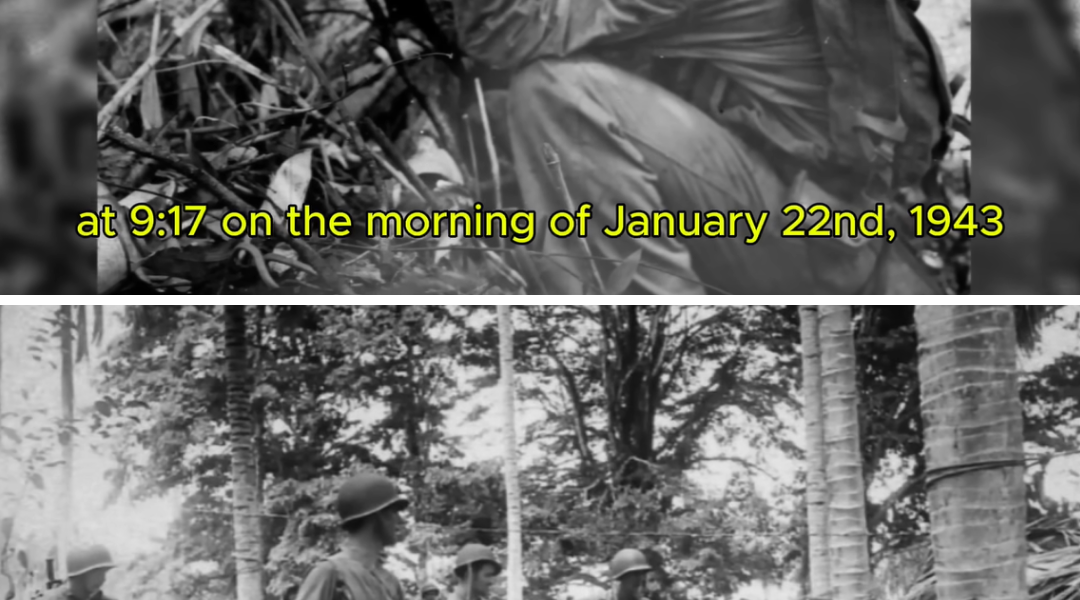
At 9:17 on the morning of January 22, 1943, Second Lieutenant John George lay motionless inside the broken concrete shell of a captured Japanese bunker west of Point Cruz, Guadalcanal. The bunker was half-collapsed, overgrown with vines and moss, its firing slits now looking out over coconut groves and dense jungle. Through the scope of his rifle, George studied a banyan tree 240 yards away, its massive trunk rising into a tangled canopy nearly ninety feet above the ground. The rifle in his hands was one the other officers had mocked for weeks—a civilian bolt-action with a mail-order scope. To George, it was not a curiosity. It was a solution.
George was twenty-seven years old, an Illinois state shooting champion, and until that morning, he had zero confirmed kills. In the past seventy-two hours, Japanese snipers hidden in these groves had killed fourteen men from the 132nd Infantry Regiment. They struck without warning—shots from trees the patrols had passed twice, sometimes three times, without seeing a thing. The battalion commander knew something had to change.
The rifle in George’s hands had been controversial from the start. When he unpacked his Winchester Model 70, fitted with a Lyman Alaskan scope and Griffin & Howe mount, back at Camp Forrest in Tennessee, the armorer had laughed and asked whether it was meant for deer or Germans. George replied simply that it was meant for the Japanese. The rifle never even made it onto the transport ship with him. It sat in a warehouse in Illinois while George sailed to the Pacific carrying a standard M1 Garand like everyone else.
Six weeks later, in late December 1942, a supply sergeant handed George a wooden crate marked Fragile. Inside was the rifle he had bought with two years of National Guard pay. It weighed slightly more than a Garand and held only five rounds, but it had something no issued rifle in the battalion possessed—magnification. The battalion commander ordered George to leave it in his tent. George carried it anyway.
By the time the 132nd Infantry relieved the Marines on Guadalcanal, the fighting had already been brutal. Henderson Field had been taken and held, but Mount Austen and the western coastal groves remained infested with Japanese holdouts. The jungle west of the Matanikau River was not bunker warfare anymore—it was sniper warfare. And the Japanese were very good at it.
On the night of January 21, the battalion commander summoned George. Snipers were killing his men faster than malaria. He wanted to know if that “sporting rifle” could do anything useful. George explained his background calmly: Illinois State Champion at 1,000 yards, six-inch groups at 600 yards, and near-perfect scores with iron sights before the war. The commander gave him one morning to prove it.
George spent the night cleaning the rifle, removing the last traces of cosmoline, checking the scope mounts, and loading five rounds of .30-06 ball ammunition. At dawn, he moved alone into the ruins of the captured bunker overlooking Point Cruz. He brought no spotter, no radio—only his rifle, a canteen, and sixty rounds of ammunition in stripper clips.
The jungle woke slowly. Birds, insects, distant artillery. George filtered it all out and focused on movement.
At 9:17 a.m., he saw it. A branch shifted—no wind, no birds. Eighty-seven feet up in the banyan tree, a dark shape resolved itself into a man. The Japanese sniper was facing east, watching the supply trail used by George’s battalion. George adjusted two clicks for wind, controlled his breathing, and squeezed the trigger.
The Winchester cracked once.
The sniper jerked and fell, tumbling through the branches before hitting the ground near the base of the tree. George worked the bolt smoothly and stayed on the scope. Japanese snipers worked in pairs. The second man would be close.
Twenty-six minutes later, he found him—lower in another tree, retreating. George led the movement and fired. The second sniper fell backward, his rifle clattering through the branches. Two shots. Two kills.
By noon, George had killed five snipers. Word spread quickly. The jokes stopped. Men who had mocked the rifle now asked to watch him work. George refused. Spectators drew attention, and attention drew fire.
The Japanese adapted. After the fifth kill, movement stopped. George spent the afternoon glassing trees and seeing nothing. At dawn the next day, rain fell hard, masking sound and movement. When it cleared, George resumed his watch. He killed the sixth sniper at longer range. Then the Japanese tried something new.
Mortars.
The first rounds landed short. The second closer. George ran just as the third salvo obliterated the bunker he had occupied moments before. He relocated to a fallen tree, then another position, then another. This was no longer marksmanship—it was a duel.
By the end of the second day, George had eight confirmed kills using only twelve rounds.
That night, he did not sleep. Eight were dead. Three remained. Those three would be the best.
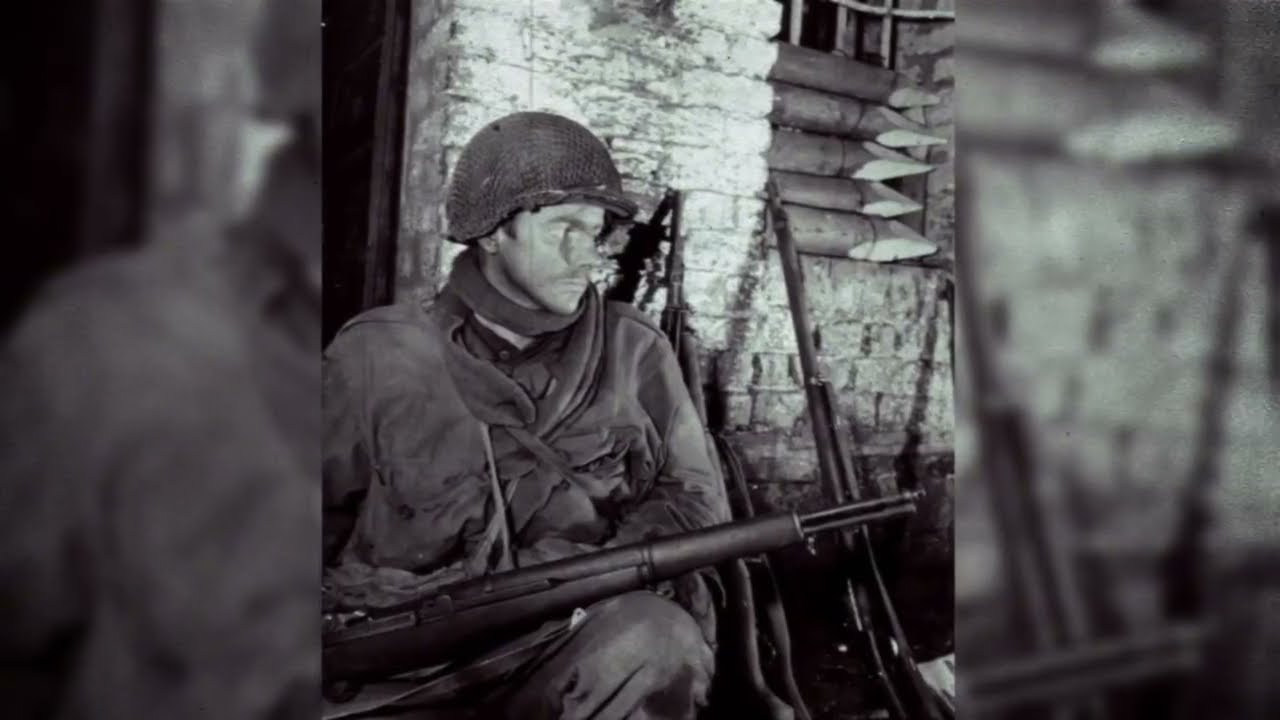
On January 24, George chose a new position—a rock cluster once used as a Marine machine-gun nest. When the rain lifted, he spotted a sniper in a palm tree. Something felt wrong. It was too obvious. George scanned wider and found the real threat: a perfectly concealed sniper in a banyan tree watching the wrong location.
George used the decoy against them.
He killed the bait sniper first. As expected, the real sniper shifted. George fired again. Two shots. Two kills. But now his position was compromised. Japanese infantry moved in to recover the bodies.
George submerged himself in a water-filled shell crater and waited.
When the soldiers came too close, he rose and fired from the water. One fell. Then another. Then another. Outnumbered and nearly out of ammunition, George broke contact and slipped back toward American lines.
By 11:13 a.m., he reached friendly positions.
George reported eleven Japanese snipers killed in four days. Three more enemy soldiers died during the final engagement. His rifle had fired fewer than twenty rounds.
The battalion commander asked one question: could George train others?
Within days, George formed a sniper section using scoped Springfields left behind by the Marines. He trained forty expert marksmen in fieldcraft, patience, and fire discipline. Within two weeks, the section recorded seventy-four confirmed kills with zero American casualties during sniper operations.
The Japanese evacuation of Guadalcanal accelerated soon after.
George’s war did not end there. He volunteered for a classified jungle unit in Burma—Merrill’s Marauders. He modified his rifle for weight and carried it across mountains and jungles thought impassable. He fired it only seven times in Burma—seven shots, seven kills.
After the war, George returned home quietly. He later wrote Shots Fired in Anger, a precise, unemotional account of jungle combat and marksmanship that became a classic. He never boasted. He never dramatized.
John George died in 2009 at age ninety.
His Winchester Model 70 now sits in a museum. To most visitors, it looks like an ordinary hunting rifle. But it is not.
It is the rifle that proved individual skill still mattered in industrial war.
The rifle that ended a sniper campaign when an entire battalion could not.
The rifle that turned patience, discipline, and precision into survival.
And the story of the man who carried it reminds us that sometimes, wars are changed not by armies—but by one soldier who refuses to miss.