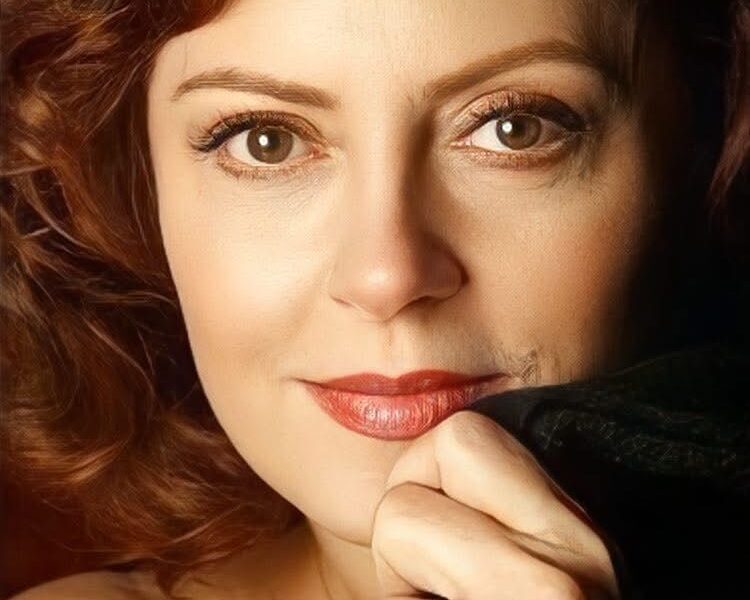

There is a certain kind of woman Hollywood never quite knows how to contain. She arrives not with scandal, not with glittering fragility, but with intelligence sharp enough to unsettle a room. She smiles without apology. She speaks without asking permission. And when she walks into the frame, the camera does not merely capture her beauty — it captures conviction. For more than five decades, Susan Sarandon has been that woman. But who is she, really? An Academy Award–winning actress? A political activist? A rebel disguised as a movie star? Or something far more complicated — something still hidden beneath the surface of fame?
The public knows her face long before it knows her story. The red hair. The fearless gaze. The unmistakable presence that commands a scene even in silence. Yet the mystery of Susan Sarandon does not live in her filmography alone. It lives in the contradictions. The softness that coexists with defiance. The sensuality that refuses to be objectified. The warmth that can turn into fire when justice is at stake. To understand who she is, one must begin not on a red carpet, but in the quiet uncertainty of a young girl who did not know she was destined to disrupt an entire industry.
Born in 1946 in New York City, raised in a Catholic household in New Jersey, Susan grew up surrounded by discipline and expectation. There was no prophecy of stardom hovering over her childhood. She was not groomed for celebrity. She studied drama at Catholic University, not with the hunger of someone chasing fame, but with the curiosity of someone trying to understand the world. Even then, there was a restlessness in her, a quiet refusal to shrink into conventional roles. And yet, if you had met her then, you might never have guessed she would become one of the most recognizable names in American cinema.
Her entry into acting was almost accidental. She accompanied her husband at the time to an audition, and somehow, improbably, she walked away with a role herself. It was the beginning of a journey that would move through the unpredictable landscape of Hollywood — a world that builds women up and tears them down with equal enthusiasm. In the early years, she worked steadily but without spectacle. Television roles. Small film parts. The industry saw her talent, but it did not yet understand her power.
That changed in 1975 with The Rocky Horror Picture Show, a cult classic that would outlive trends and redefine her public image. As Janet Weiss, she moved from innocence to awakening before the audience’s eyes. The performance was daring, playful, provocative. It hinted at something deeper — a woman willing to explore transformation on screen, to embrace vulnerability without losing control. The film became a cultural phenomenon, and Susan Sarandon became a name whispered in midnight screenings across America. But even then, something about her trajectory felt unfinished, as though she were only warming up for a role far more significant.
The 1980s and early 1990s revealed her range in ways Hollywood could no longer ignore. In films like Bull Durham and Atlantic City, she blended sensuality with intelligence, desire with dignity. She refused to be cast as decoration. She chose roles that contained emotional complexity, women who were flawed yet formidable. And then came 1991 — the year Thelma & Louise exploded onto screens and into cultural history.
In Thelma & Louise, Susan Sarandon did not merely act; she embodied rebellion. The film became more than a road movie. It became a manifesto, a feminist milestone, a cinematic thunderclap. As Louise, she portrayed a woman carrying trauma with quiet strength, a woman who would rather drive into the unknown than return to confinement. The performance earned her an Academy Award nomination, but awards felt almost secondary to the impact. Women saw themselves in Louise’s anger, her loyalty, her refusal to accept injustice. Men were forced to confront a narrative that did not revolve around them. The movie did not ask for permission to exist. Neither did she.

Yet success in Hollywood is rarely simple. For every triumph, there is scrutiny. For every award nomination, there is backlash. Susan Sarandon’s outspoken political activism began drawing as much attention as her acting. She spoke against war, advocated for human rights, supported progressive causes long before celebrity activism became fashionable. She attended protests. She used her platform to amplify uncomfortable truths. Some praised her courage. Others labeled her controversial. But she did not retreat.
Her Oscar win for Dead Man Walking in 1995 marked a turning point. Portraying Sister Helen Prejean, a nun advocating against the death penalty, she delivered a performance that was both restrained and devastating. It was not glamorous. It was not flashy. It was moral, human, raw. She did not play the role to win an Academy Award; she played it to illuminate a conversation about justice, redemption, and compassion. When she accepted the Oscar for Best Actress, she did not soften her message. She stood firm in her beliefs, even as cameras flashed and applause thundered around her.
But what the audience rarely saw were the private costs of living so publicly. Relationships strained under the weight of fame. Her long partnership with actor Tim Robbins ended after more than two decades together. The headlines speculated. The gossip columns dissected. Yet behind the noise was a woman navigating heartbreak with the same quiet dignity she brought to her characters. She did not reinvent herself to satisfy public expectation. She simply continued.
Aging in Hollywood presents its own battle, particularly for women. The industry often sidelines actresses once they pass a certain age, as though depth and experience were liabilities. Susan Sarandon refused that narrative. She embraced roles that celebrated mature complexity. She posed unapologetically. She spoke candidly about sexuality, motherhood, and independence. She did not hide wrinkles; she wore them like medals of survival.
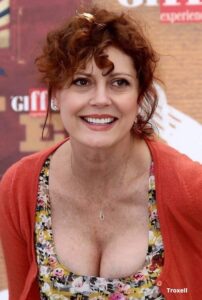
Her career extended beyond cinema into television, Broadway, and documentary work. She lent her voice to causes others feared to touch. She supported climate justice, racial equality, and refugee rights. Critics sometimes accused her of being too political, too outspoken, too unwilling to conform. Yet those accusations seemed only to confirm what had always been true: she was not built for silence.
And still, beneath the awards, beneath the activism, beneath the iconic red carpet appearances, there remains an element of mystery. Who is Susan Sarandon when the cameras turn off? When the applause fades? When the headlines move on? Those who have worked with her describe warmth, humor, fierce loyalty. They describe a woman who listens carefully before speaking. A woman who studies, questions, reflects. The fire is real, but so is the empathy.
Her children have spoken of her as present, engaged, imperfect but loving. Motherhood shaped her as deeply as any film role. It grounded her. It reminded her that legacy is not measured solely in box office numbers or Oscar nominations, but in human connection. In private, she has admitted fear, doubt, vulnerability — emotions that contrast sharply with her public strength. And perhaps that is the secret: the bravery audiences admire is not the absence of fear, but the decision to move forward despite it.
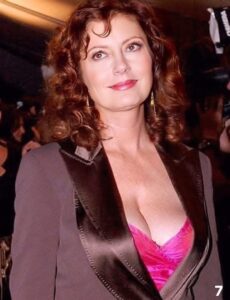
Over decades, her net worth has grown, her real estate investments have expanded, her influence in the entertainment industry has solidified. Financial success, luxury living, Hollywood prestige — all the markers of celebrity wealth follow her name in search engines. But the essence of Susan Sarandon cannot be captured by metrics or high RPM keywords like celebrity net worth, Oscar-winning actress, or Hollywood career longevity. Those are merely headlines. The truth lives elsewhere.
It lives in the young actress who risked being labeled difficult because she refused to compromise her values. It lives in the middle-aged woman who embraced her sexuality without apology. It lives in the activist who chose conviction over comfort. It lives in the artist who understands that storytelling can shift culture.
There were moments — and there will likely be more — when public opinion turned against her. When social media storms questioned her stances. When studios hesitated. But she has never recalibrated her identity to suit popularity. She has allowed herself to be misunderstood rather than diluted. That choice, more than any award, defines her.
And so we return to the question: who is Susan Sarandon?
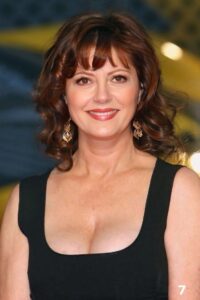
She is not simply an Academy Award winner. Not just a feminist icon. Not merely a political activist. She is a woman who has lived visibly and imperfectly in a culture that punishes both. She is a reminder that fame does not erase complexity. That beauty does not cancel intellect. That conviction does not require cruelty.
Perhaps the most compelling part of her story is not the films we know, but the resilience we sense. The way she continues to evolve. The way she refuses to calcify into nostalgia. Even now, decades into her career, she remains unpredictable. Curious. Alive.
There is something unfinished about her narrative, something that suggests the final chapter has not yet been written. She is still speaking, still challenging, still creating. And maybe that is the true definition of legacy — not a frozen image in Hollywood’s Golden Age, but a living presence that refuses to fade.
In the end, Susan Sarandon is not a mystery because we lack information. She is a mystery because she refuses to be reduced. Because every time the world thinks it understands her, she reveals another layer. Another conviction. Another act of courage.
And perhaps the most powerful secret of all is this: she was never trying to be iconic. She was simply trying to be honest.
The rest followed.