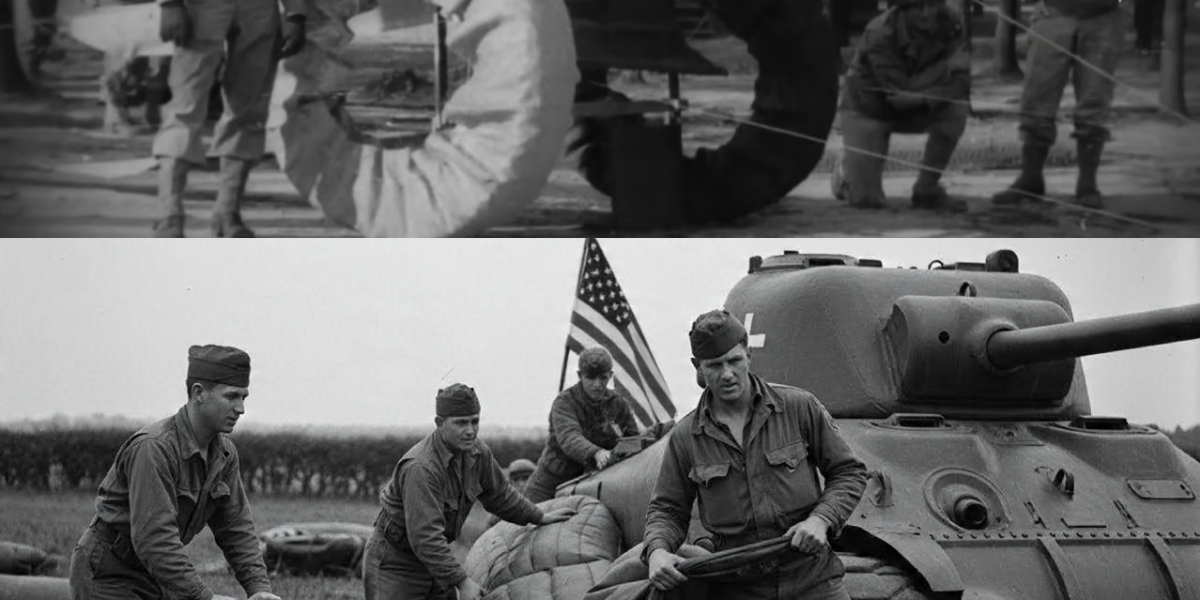
1,100 artists and actors fought their own war —using rubber tanks and giant speakers to trick Hitler. VD

1,100 artists and actors fought their own war —using rubber tanks and giant speakers to trick Hitler
War is often defined by the weight of steel and the roar of engines. But in 1944, a secret unit of the U.S. Army proved that sometimes, the most lethal weapon on the battlefield isn’t a bullet—it’s an illusion.
This is the story of the 23rd Headquarters Special Troops, better known to history as the “Ghost Army.” For decades, their exploits remained a “Code Red” secret, classified by the Pentagon to preserve their terrifyingly effective techniques. Comprised of 1,100 artists, actors, and sound engineers, this unit saved an estimated 15,000 to 30,000 lives using nothing but rubber, record players, and pure, unadulterated nerve.

The Art of Deception: Recruitment and Doctrine
In early 1944, while the world prepared for the brute force of D-Day, a different kind of recruitment was happening in the art schools of New York and Philadelphia. Colonel Billy Harris and Major Ralph Ingersoll realized that if the Allies were to survive the invasion of Europe, they needed to make the German Wehrmacht look in the wrong direction.
They didn’t look for marksmen; they looked for creative minds. They recruited fashion designer Bill Blass, painter Ellsworth Kelly, and photographer Art Kane. These were men with an average IQ of 119, capable of understanding the nuances of shadow, perspective, and human psychology.
Their toolkit was bizarre:
-
Visual Deception: Inflatable rubber M4 Sherman tanks, trucks, and artillery pieces that weighed only 93 lbs but looked like 33-ton monsters from 500 yards away.
-
Sonic Deception: Massive 500-lb speakers mounted on halftracks that could project the recorded sounds of a tank division’s movement over 15 miles.
-
Radio Deception: Expert signalmen who mimicked the “fists” (the unique typing rhythms) of operators from real units to create a phantom network of communication.
-
Special Effects: Actors who would go into local French cafes wearing fake unit patches, spinning “loose lips” tales for German spies to overhear.
Operation Brittany: The First Masterpiece
The Ghost Army’s first true test came in August 1944, during the race across France. General George S. Patton’s Third Army was moving fast, but he needed to protect his flank.
The Ghost Army moved into the breach. While the real armored divisions slipped east toward Paris, the 23rd stayed behind to play “theater.” They inflated hundreds of tanks and set up massive speakers. Every night, they broadcast the sound of clanking treads and shouting sergeants.
German intelligence bit the bait. They reported four American combat teams heading south into Brittany. Hitler’s commanders diverted entire divisions to counter this “massive threat,” only to find empty fields once the real battle had already moved miles away.
The Siege of Brest: Rubber vs. 88mm Guns
By late August, Sergeant Bob Tomkins found himself outside the fortress city of Brest. The Germans had 38,000 troops and dozens of the dreaded 88mm anti-tank guns defending the port.
Tomkins’ mission was “Code Red” dangerous: inflate 15 Shermans by dawn to make General Ramcke think 30,000 Americans were preparing to strike his right flank.
The compressor hissed in the dark. Each 93-lb rubber tank took 20 minutes to take shape. While Tomkins inflated the “armor,” Private James Anderson used a bulldozer to create fake tank tracks in the mud, ensuring that even aerial reconnaissance would be fooled.
The deception worked—too well. German observers in a nearby church tower called in the coordinates. Within hours, the Germans repositioned up to 50 of their 88mm guns away from the center of the American line. When the real attack began on August 25th, the American infantry found the German defenses thinned out. The rubber tanks had drawn the fire, and though they were shredded by shrapnel, they saved the real steel.
The Battle of the Bulge: Phantoms in the Snow
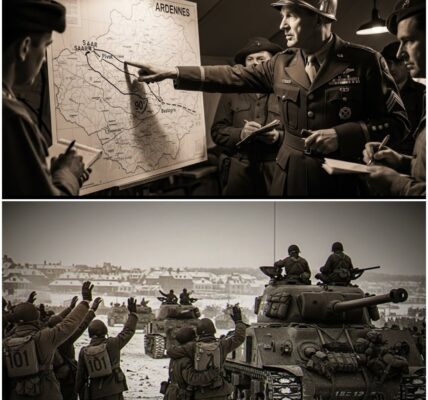
In December 1944, Hitler launched his final gamble: the Ardennes Offensive. The American lines were shattered. Amidst the chaos of the Battle of the Bulge, the Ghost Army was tasked with Operation Kodak.
With no visual decoys available in the frozen terrain, they turned to “Radio Deception.” They mimicked the 75th Infantry Division and the 6th Armored Division. For four days, they filled the airwaves with fake supply requests, fuel requisitions, and patrol reports.
German direction-finding equipment tracked these phantom divisions, convinced that American reserves were arriving to reinforce the besieged town of Bastogne. German commanders hesitated, diverting resources to counter these ghost reinforcements. That four-day delay gave Patton enough time to reach the 101st Airborne. The “Phantom Legion” had held a 50-mile gap in the line with nothing but radio waves.
The Rhine Crossing: The Final Act
The Ghost Army’s largest operation, Operation Viersen, took place in March 1945. To facilitate the crossing of the Rhine River, the unit simulated two full corps—30,000 men.
They set up 600 inflatable vehicles and broadcasted 24-hour construction noise. German artillery responded with the heaviest bombardment the unit had ever faced. 12 Ghost Army soldiers were wounded as shrapnel tore through their rubber decoys.
But the “theater” was a success. When the real 9th Army crossed 15 miles to the south, the German defenders were looking the other way. General William Simpson later commended the unit, stating their deception saved thousands of lives.
The Cost of Silence
The war in Europe ended on May 8, 1945. The Ghost Army had performed 21 operations. Their final tally was three men killed and 48 wounded.
However, their greatest struggle was the one that began after the guns fell silent. Upon returning home, every member of the 23rd was sworn to secrecy. They signed documents stating that discussing their work would result in a court-martial. For 50 years, they couldn’t even tell their wives or children that they had lifted tanks or broadcasted phantom engines.
Recognition at Last
The Ghost Army’s records weren’t declassified until 1996. By then, many of the 1,100 phantoms had already passed away, taking their secrets to the grave.
Finally, in 2024, the surviving veterans were awarded the Congressional Gold Medal, the highest civilian honor in the United States. Only three members were still alive to receive it. Seymour Nussenbaum, Bernard Bluestein, and John Christman—all nearly 100 years old—stood as the last representatives of an army that won battles without firing a shot.
Sergeant Bob Tomkins passed away in 2003. When his daughter was cleaning out his house, she found a small, battered notebook hidden in a box. Inside were sketches of inflatable Shermans and notes on German listening posts. He had broken the rules to keep a record of the truth.
The Ghost Army proved that in the theatre of war, creativity is as vital as ammunition. They were bait, they were actors, and they were heroes. They fought in the shadows, so that thousands of others could walk in the sun.
Note: Some content was generated using AI tools (ChatGPT) and edited by the author for creativity and suitability for historical illustration purposes.